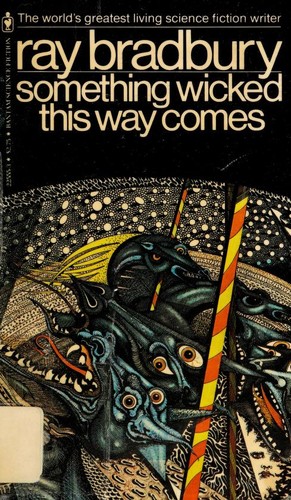
Something Wicked This Way Comes
Ray Bradbury (1962)
“A traveling carnival offers you everything you ever wanted — your youth back, your secret desires fulfilled — and it only costs your soul.”
This page prints on a single page. Use Ctrl+P / Cmd+P.
Something Wicked This Way Comes
Ray Bradbury (1962) · 293pages · Postmodern / American Gothic · 2 AP appearances
Summary
Two thirteen-year-old boys, Will Halloway and Jim Nightshade, discover that a mysterious carnival has arrived in their small Illinois town one October night. Led by the sinister Mr. Dark, the Illustrated Man, the carnival preys on townspeople's deepest desires — offering youth to the old, maturity to the young, beauty to the plain — but every gift is a trap that enslaves the recipient. When the boys learn the carnival's secret, Mr. Dark hunts them through the town. It falls to Will's father Charles, a fifty-four-year-old librarian who considers himself a failure, to defeat the carnival — not through violence, but through laughter, love, and the radical acceptance of mortality.
Why It Matters
Something Wicked This Way Comes is the foundational text of American dark fantasy — the book that proved literary horror could be lyrical, philosophical, and emotionally generous. Before Bradbury, horror in American fiction was either pulp (entertaining but disposable) or Gothic (Poe, Hawthorne —...
Themes & Motifs
Diction & Style
Register: Lyrical prose-poetry layered over Midwestern colloquial dialogue — Bradbury writes like a poet disguised as a storyteller
Narrator: Third-person omniscient but highly subjective — the narrator inhabits each character's consciousness in turn, adoptin...
Figurative Language: Extremely high
Historical Context
Early 1960s America — Cold War anxiety, suburban conformity, the last years before the counterculture: The novel was written during the peak of American conformity and Cold War terror — a period when the culture encouraged people to suppress fear and perform normalcy. Bradbury's carnival is a metaph...
Key Characters
Talking Points
- Why does Bradbury make Charles Halloway — a middle-aged librarian, not a warrior or a young hero — the person who defeats Mr. Dark? What is Bradbury arguing about the nature of heroism?
- The carousel ages or de-ages its riders by one year per revolution. Why is this mechanism more terrifying than a simple monster? What makes the manipulation of time a more effective horror device than physical violence?
- Will Halloway and Jim Nightshade are born on either side of midnight. How does this birth timing function as both characterization and symbolism? Could the novel work if both boys had the same temperament?
- Bradbury argues that laughter and joy are literal weapons against evil. Is this a naive position, or is there genuine philosophical depth to the claim? What would a skeptic say, and how might Bradbury respond?
- Mr. Dark's tattoos are living souls of people the carnival has consumed. How does this body-as-text metaphor function? What does it mean that Dark literally wears his victims?
Why Read This
Because this is the novel that proves horror can be literature — and literature can be thrilling. Bradbury writes sentences you will remember for the rest of your life, and he does it while telling a story about a father who saves the world by bei...