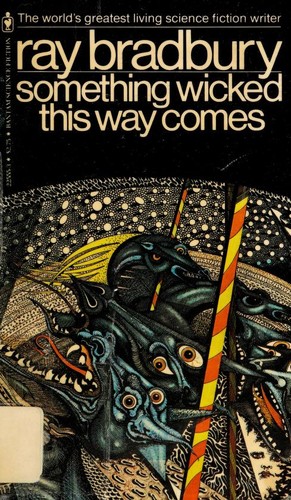
Something Wicked This Way Comes
Ray Bradbury (1962)
“A traveling carnival offers you everything you ever wanted — your youth back, your secret desires fulfilled — and it only costs your soul.”
Essay Questions & Food for Thought
30questions designed to challenge assumptions and provoke original thinking. These can't be answered from a summary — you need the actual text.
Why does Bradbury make Charles Halloway — a middle-aged librarian, not a warrior or a young hero — the person who defeats Mr. Dark? What is Bradbury arguing about the nature of heroism?
The carousel ages or de-ages its riders by one year per revolution. Why is this mechanism more terrifying than a simple monster? What makes the manipulation of time a more effective horror device than physical violence?
Will Halloway and Jim Nightshade are born on either side of midnight. How does this birth timing function as both characterization and symbolism? Could the novel work if both boys had the same temperament?
Bradbury argues that laughter and joy are literal weapons against evil. Is this a naive position, or is there genuine philosophical depth to the claim? What would a skeptic say, and how might Bradbury respond?
Mr. Dark's tattoos are living souls of people the carnival has consumed. How does this body-as-text metaphor function? What does it mean that Dark literally wears his victims?
Compare Jim Nightshade's desire to ride the carousel forward with Miss Foley's desire to ride it backward. Both want to change their age. Is one desire more sympathetic than the other? Why or why not?
The novel is set in October. Why is autumn — rather than winter, summer, or spring — essential to the story's themes? Could the carnival arrive in July and still function?
Charles Halloway discovers the carnival's history through library research. What is Bradbury saying about the relationship between knowledge and courage? Is understanding evil sufficient to defeat it?
The Dust Witch navigates by sensing heartbeats. Charles defeats her by laughing, which changes his heartbeat's rhythm. Analyze this as a metaphor for emotional self-defense. What does it mean to make yourself 'unreadable' to a predator?
Bradbury spent fourteen years developing this story. How does the novel's extended composition period manifest in the text? What qualities does it have that a quickly written novel might lack?
The carnival offers people exactly what they want. Why is getting what you want presented as the novel's greatest horror? Connect this to real-world examples of desire fulfilled destructively.
How does Charles Halloway's embrace of Mr. Dark — killing evil through physical affection rather than violence — challenge conventional fantasy and horror narratives? Name three other works where evil is defeated through love, and compare the methods.
Mr. Cooger de-ages into a twelve-year-old and infiltrates Miss Foley's home. What is Bradbury saying about the vulnerability of lonely people to deception? How does loneliness function as the carnival's entry point?
Bradbury's prose is often described as 'poetic.' Select a passage of at least five sentences and analyze its rhythm, imagery, and sound. How does the style serve the content? Could this story be told in minimalist prose?
The novel's title comes from Macbeth (Act 4, Scene 1): 'By the pricking of my thumbs, / Something wicked this way comes.' Why does Bradbury borrow from Shakespeare's witches? What connection exists between Macbeth's themes and this novel's?
Jim nearly dies because of his desire to grow up faster. Is Bradbury arguing that the desire to mature is inherently dangerous, or that there is a difference between natural growth and forced growth? What is that difference?
The Mirror Maze shows visitors their deepest fears — specifically, their aged selves. Why is the image of one's own old age more frightening than monsters, ghosts, or death itself?
Charles Halloway feels inadequate because he had Will late in life. How does the novel ultimately reframe 'old fatherhood' from weakness to strength? What does Charles have at fifty-four that he would not have had at twenty-five?
Stephen King has called this 'the best book of its type.' What 'type' is it? Is it horror, fantasy, coming-of-age, philosophical fiction, or something that resists categorization? Argue for a genre classification and defend it.
The carnival keeps returning every generation. Why doesn't Bradbury let it be destroyed permanently? What does the carnival's recurrence say about the permanence of human vulnerability?
Compare the carnival in Something Wicked This Way Comes to the Party in The Great Gatsby. Both are spectacles that mask something predatory. How do Bradbury and Fitzgerald use entertainment as a metaphor for exploitation?
Tom Fury, the lightning rod salesman, warns the town and then disappears. Why does Bradbury include a prophetic figure who cannot prevent the disaster he predicts? What literary tradition does Fury belong to?
The novel argues that evil cannot comprehend joy. Is this psychologically plausible? Are there real-world parallels — systems or institutions that genuinely cannot process human happiness?
Will and Jim revive Jim not through CPR or medicine but through dancing, singing, and laughing. Is this a failure of realism, or is Bradbury operating under a different set of rules? Defend the scene's internal logic.
How does Bradbury's own childhood encounter with a real carnival performer called 'Mr. Electrico' — who told young Ray to 'Live forever!' — inform the novel's treatment of immortality? Is the novel's answer to 'Live forever' a yes or a no?
The novel contains almost no female characters with agency — Miss Foley is a victim, the Dust Witch is a weapon. Is this a limitation of Bradbury's imagination, a reflection of 1962 gender norms, or a deliberate choice in a novel about fathers and sons?
Bradbury writes that 'the stuff of nightmare is their plain bread. They butter it with pain.' Analyze this sentence's construction. How does the domestic metaphor (bread and butter) make the horror more unsettling rather than less?
The carousel plays a calliope — a steam organ associated with circuses and carnivals. How does Bradbury use sound throughout the novel? Trace the role of music, silence, and noise as indicators of the carnival's power.
If you were to update this novel for the present day, what would the carnival look like? What modern 'rides' would exploit the same desires — youth, beauty, power, escape from the present moment?
The novel ends at dawn with father and sons walking home. Why is the walk home — not the battle, not the victory — the novel's real ending? What does Bradbury value more: defeating evil or living well afterward?