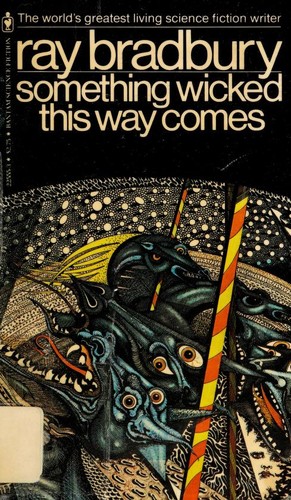
Something Wicked This Way Comes
Ray Bradbury (1962)
“A traveling carnival offers you everything you ever wanted — your youth back, your secret desires fulfilled — and it only costs your soul.”
Something Wicked This Way Comes— Historical Context & Author Background
Author: Ray Bradbury · Published 1962· Era: Postmodern / American Gothic·293 pages
Themes explored: good-vs-evil, aging, father-son, temptation, joy-vs-fear, autumn, innocence
About Ray Bradbury
Ray Douglas Bradbury (1920-2012) grew up in Waukegan, Illinois — the model for 'Green Town' in this novel and in Dandelion Wine. He never attended college, educating himself at the public library (Charles Halloway's workplace is autobiographical). Bradbury wrote the novel's seed story, 'The Black Ferris,' in 1948, then spent fourteen years expanding it — first into a screenplay for Gene Kelly that was never produced, then into the novel published in 1962. He was forty-two when it was published, acutely aware of aging and fatherhood. Bradbury famously never learned to drive and never flew in an airplane, yet wrote some of the most celebrated science fiction and fantasy of the twentieth century.
Life → Text Connections
How Ray Bradbury's real experiences shaped specific elements of Something Wicked This Way Comes.
Bradbury grew up in Waukegan, Illinois, and spent his childhood at the local library, which he called 'the real university'
Green Town is Waukegan; Charles Halloway works at the library and discovers the carnival's weakness through books
The library as salvation is not metaphorical for Bradbury — it literally saved him from poverty and limited education. Charles's heroism is a tribute to what libraries made possible.
Bradbury was a father of four daughters and was deeply preoccupied with the passage of time as he entered his forties
Charles Halloway's anguish about being an old father, his fear that he cannot connect with Will across the generational gap
The father-son dynamic is Bradbury working through his own anxieties about aging and parenthood. Charles's redemption is Bradbury's prayer for himself.
As a boy in Waukegan, Bradbury attended a traveling carnival where a performer called 'Mr. Electrico' touched him with an electric sword and commanded: 'Live forever!'
Mr. Electrico in the novel — the mummified Cooger kept alive by electricity — and the carnival's false promise of immortality
The real Mr. Electrico's command became Bradbury's artistic mission. The novel asks whether 'live forever' is a blessing or a curse, and answers: it depends on how you define living.
Bradbury spent fourteen years developing the story, from short story to unproduced screenplay to novel
The novel's density and thematic richness — its feeling of long meditation compressed into a single narrative
The extended gestation allowed Bradbury to embed multiple philosophical layers. The novel reads quickly but reveals new depth on every rereading because it was composed slowly.
Historical Era
Early 1960s America — Cold War anxiety, suburban conformity, the last years before the counterculture
How the Era Shapes the Book
The novel was written during the peak of American conformity and Cold War terror — a period when the culture encouraged people to suppress fear and perform normalcy. Bradbury's carnival is a metaphor for every institution that profits from human anxiety: advertising, propaganda, consumer culture. His insistence that joy and self-acceptance are the antidote to fear reads as a direct challenge to the era's culture of suppression. The small-town Illinois setting is deliberately nostalgic — Bradbury is writing about a 1920s childhood from a 1960s perspective, looking back at a simpler America that may never have existed, much as his characters look back at a youth they cannot recover.
Why Something Wicked This Way Comes Matters Historically
Something Wicked This Way Comes is the foundational text of American dark fantasy — the book that proved literary horror could be lyrical, philosophical, and emotionally generous. Before Bradbury, horror in American fiction was either pulp (entertaining but disposable) or Gothic (Poe, Hawthorne — brilliant but psychologically narrow). Bradbury created a third path: horror as a vehicle for exploring what it means to be human, mortal, and afraid. The novel's influence on Stephen King, Neil Gaiman, and virtually every subsequent writer of literary horror is direct and acknowledged.
- One of the first American novels to treat horror and fantasy with the literary seriousness previously reserved for 'realist' fiction
- Pioneered the 'small-town menace' subgenre that Stephen King would later make his own
- One of the earliest novels to make a middle-aged, physically unremarkable man the hero of a fantasy — predating the 'ordinary hero' trope by decades
Occasionally challenged in school libraries for its depiction of witchcraft, occult themes, and what some parents have called 'demonic imagery.' The irony is considerable — the novel's explicit moral is that love, laughter, and family togetherness are the only forces that can defeat darkness.