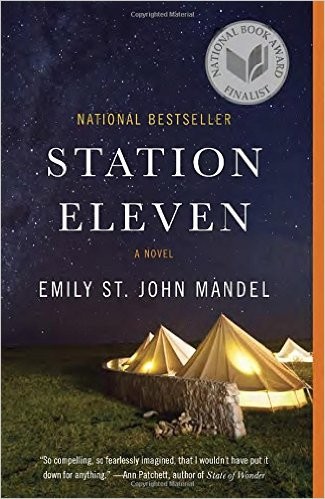
Station Eleven
Emily St. John Mandel (2014)
“After a pandemic kills most of humanity, a traveling Shakespeare troupe moves through the ruins — because 'survival is insufficient.'”
Station Eleven— Historical Context & Author Background
Author: Emily St. John Mandel · Published 2014· Era: Contemporary·333 pages
Themes explored: art, survival, memory, connection, civilization, loss, beauty, meaning
About Emily St. John Mandel
Emily St. John Mandel was born in 1979 in British Columbia, Canada, and grew up on Denman Island — the model for Arthur's isolated Delano Island. She moved to Toronto, then New York, working in administrative and corporate jobs while writing fiction at night, publishing three crime novels before Station Eleven. She began writing Station Eleven without having read much post-apocalyptic fiction — she wanted to write about what comes after rather than the catastrophe itself. The novel was published to immediate critical acclaim, won the Arthur C. Clarke Award, and was a finalist for the National Book Award. Its television adaptation aired in 2021, during the COVID-19 pandemic, which transformed the book's cultural resonance.
Life → Text Connections
How Emily St. John Mandel's real experiences shaped specific elements of Station Eleven.
Mandel grew up on a small island in British Columbia, isolated, community-based
Arthur Leander's Delano Island origins — the small, known world he loses to fame
The island represents a human scale that celebrity destroys. Mandel draws on her own formation as a model for what Arthur can't get back.
Mandel worked in administrative and corporate jobs while writing in stolen hours
Miranda Carroll creating her graphic novel on napkins and margins — art as private practice, not career
Miranda's relationship to her art is autobiographical in texture. Making something in secret, for years, with no audience, is what Mandel did before Station Eleven succeeded.
Mandel began writing the novel without a 'what if' disaster scenario — she wanted to write about theater, Shakespeare, and the question of why art matters
The Traveling Symphony performing Shakespeare in parking lots as the novel's ethical center
The apocalypse is the novel's structure, not its subject. Its subject is always the question the Symphony embodies: why bother with art when survival is uncertain?
Historical Era
2014 — post-2008 financial crisis anxiety, pre-COVID, peak social media era
How the Era Shapes the Book
Station Eleven was published at the intersection of pandemic anxiety and digital saturation. The novel's central question — what is worth preserving from the old world? — lands differently in an era when everything is theoretically preserved digitally but felt increasingly fragile. The COVID-19 pandemic (2020) transformed the novel's cultural context entirely: suddenly it was not speculative but resonant in a new and uncanny way. Readers who'd found the pandemic premise far-fetched in 2014 were reading it in 2020 from locked-down apartments.
Why Station Eleven Matters Historically
Station Eleven revitalized post-apocalyptic fiction as a literary genre — demonstrating that science fiction's speculative frame could carry the same emotional and moral weight as literary fiction. It won the Arthur C. Clarke Award and was a finalist for the National Book Award, an unusual double recognition. The COVID-19 pandemic transformed the novel from culturally resonant to uncannily prophetic, bringing it to millions of new readers. The HBO Max television adaptation (2021-22) introduced it to a generation who encountered it during the very conditions it imagined.
- One of the first post-apocalyptic novels to focus almost entirely on what comes after the crisis rather than the crisis itself
- Pioneered the use of a graphic novel as a structural metaphor within literary fiction — the comic as thematic double
- Demonstrated that science fiction's speculative premise could carry literary fiction's full emotional and moral range for mainstream audiences
Not widely banned, but occasionally challenged in school settings for adult content (Arthur's affairs, drug references) and for being 'too dark' — the irony being that Station Eleven is among the most hopeful post-apocalyptic novels ever written.