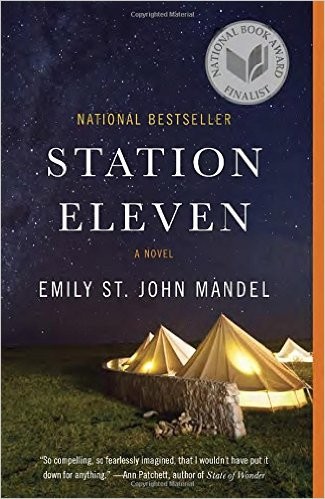
Station Eleven
Emily St. John Mandel (2014)
“After a pandemic kills most of humanity, a traveling Shakespeare troupe moves through the ruins — because 'survival is insufficient.'”
Essay Questions & Food for Thought
30questions designed to challenge assumptions and provoke original thinking. These can't be answered from a summary — you need the actual text.
The novel is structured non-linearly — moving between pre-collapse and post-collapse timelines, different years, different characters. Why does Mandel choose this structure instead of telling the story chronologically? What does it allow her to do that linear narrative couldn't?
The Traveling Symphony's motto is 'survival is insufficient' — borrowed from Star Trek: Voyager. Why does Mandel choose a pop culture quotation rather than something from Shakespeare or classical literature? What does the source say about where wisdom lives?
Miranda Carroll spends years creating a graphic novel she never publishes, printing only a few copies. It survives the end of the world in a stranger's hands. What is Mandel arguing about the relationship between an artist's intention and their work's ultimate meaning?
Arthur Leander dies on page one. He never appears alive in the novel's present tense. Why is a dead man the central character? How does Mandel make Arthur's absence into a presence?
The novel's post-collapse world includes the Museum of Civilization — a collection of smartphones, credit cards, and other old-world objects preserved for people who never knew them. Why are these objects meaningful? What does this tell us about how material culture stores memory?
The Prophet is Arthur's son Tyler, raised through the collapse years by his devout mother. Mandel gives us his backstory in detail. Is the Prophet sympathetic? Is understanding a character the same as forgiving them?
Kirsten remembers very little about the pre-collapse world — she was eight when it ended. She keeps a scrapbook of Arthur Leander's newspaper clippings. What is she preserving? What does it mean to mourn a world you barely remember?
The graphic novel 'Station Eleven' — Miranda's creation — tells the story of a space station that is also a planet, populated by survivors of a catastrophe. In what ways is Station Eleven (the graphic novel) a mirror of Station Eleven (the novel)? What does the mirroring do for the larger story?
Mandel often jumps forward in time within a scene to tell us a consequence before we've seen the present resolve: 'She would never see him again. She shook his hand.' What is the effect of this technique? How does knowing the future change how we read the present?
The Traveling Symphony performs Shakespeare — Hamlet, King Lear, A Midsummer Night's Dream — to post-collapse audiences. Why Shakespeare specifically? What does Shakespeare offer that a post-collapse settlement might need?
Jeevan's first action after learning the flu has arrived is to call every person he loves and warn them, then buy out a grocery store. Arthur's first action after each of his divorces is to begin a new relationship immediately. What do characters' first instincts in a crisis reveal about them?
The novel takes place both before and after the collapse, but we never see the worst years — the immediate aftermath, the mass death, the violence. Why does Mandel skip this period? What does she gain by refusing to dramatize it?
Clark becomes the curator of the Museum of Civilization, preserving the objects of the old world. Kirsten becomes an actress performing Shakespeare. Both are in the business of preservation — of different things. What is each of them trying to keep alive, and why does each form of preservation matter?
Miranda Carroll dies alone in a hotel in Malaysia on the first day the flu arrives there. She knows what's happening. She goes to sit by the pool and watch the stars. Is this a peaceful death? A tragic death? How does Mandel want us to feel about it?
The children born after the collapse — those who grow up in the post-collapse world — have no memory of the internet, electricity, or medicine. Mandel is interested in these children as a distinct category of human. What do they represent? What do they gain by not knowing what was lost?
The novel ends with electric lights visible from the airport — civilization beginning again somewhere to the north. Is this a hopeful ending? Is hope the right word? What is Mandel offering here, and what is she withholding?
Dr. Eleven's motto from Miranda's graphic novel is 'I stood looking over my damaged home and tried to forget the sweetness of life on Earth.' Compare this to the Traveling Symphony's motto, 'survival is insufficient.' What is the relationship between these two statements? Do they agree or contradict each other?
Station Eleven was published in 2014. It was adapted for television in 2021, when it aired during the COVID-19 pandemic. How does the pandemic context change the novel? Does a text mean something different when real events rhyme with its fictional premise?
Arthur's three marriages follow a pattern: he falls in love with someone authentic, fame absorbs them, and he moves on. What is Mandel saying about what fame does to people — not just to the famous person but to those closest to them?
The Traveling Symphony performs Shakespeare rather than contemporary plays or original works. But the Symphony also includes musicians performing classical music. Why does art that survives an apocalypse tend to be old art? What does that suggest about what makes art durable?
Frank, Jeevan's brother, chooses to stay in the apartment when the food runs out. He refuses to let Jeevan stay with him. What is Frank's choice — sacrifice, acceptance, or something else? How does Mandel want us to understand it?
Kirsten carries newspaper clippings about Arthur Leander and has memorized the two issues of Station Eleven she owns. What is the relationship between these two acts of preservation? Why does she need both?
The Georgia Flu kills 99% of humanity. The 1% who survive are not specially virtuous, specially strong, or specially chosen — they're lucky. What does the novel's randomness of survival say about how we make meaning from catastrophe?
The novel's title refers to Miranda's graphic novel, not to the post-collapse world. Why does Mandel name the novel after a work within the novel? What does the choice suggest about the relationship between the outer story and the inner one?
Compare Station Eleven to The Road by Cormac McCarthy. Both are post-apocalyptic literary novels. How do they differ in their understanding of what humanity carries forward through catastrophe?
The novel includes many small acts of care between characters: Jeevan wrapping Kirsten in his coat after Arthur dies, Clark preserving a stranger's violin in the museum, the Symphony members looking out for each other. Are these acts sufficient to carry moral weight in a novel about mass death?
Mandel builds a web of connections between characters across twenty years. Most of these connections are unknown to the characters themselves — they can't see the full pattern. What is the reader's experience of seeing the pattern that the characters can't? What does that omniscient view give us?
Arthur gave Kirsten two copies of Miranda's graphic novel — a work his ex-wife made, that he probably hadn't fully read, that she never published. Is this a meaningful gift or an accidental one? Does it matter whether Arthur understood what he was giving her?
The novel refuses to depict the worst years of the collapse — the mass violence, the starvation, the most brutal survival period. It also refuses to explain exactly how civilization is beginning to rebuild at the end. What does this twin refusal say about what Mandel thinks fiction should and shouldn't do?
Read the novel's final pages aloud. How does the prose rhythm change as the timelines converge? What does Mandel's sentence length and syntax do in the final section that it hasn't done before? What does the sound of the ending tell us about how to feel?