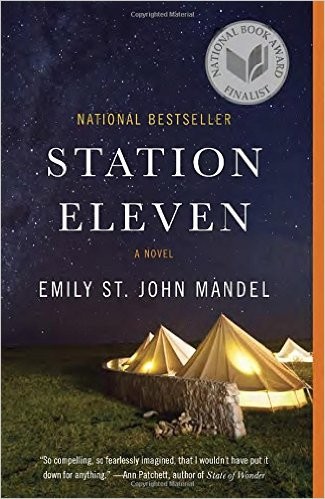
Station Eleven
Emily St. John Mandel (2014)
“After a pandemic kills most of humanity, a traveling Shakespeare troupe moves through the ruins — because 'survival is insufficient.'”
For Students
Because it asks the question every student should be asked: if civilization collapsed tomorrow and you could only carry a few things forward, what would they be? And the answer Mandel gives — Shakespeare, music, the story someone made in private and gave to a stranger — says everything about why you're sitting in that classroom. The non-linear structure teaches close reading naturally: you have to track who these people are across time and connect them yourself. That's not difficulty; that's the skill.
For Teachers
An ideal contemporary text for teaching narrative structure — the non-linear timeline gives students a framework for understanding how time functions in fiction and what authors gain by disrupting chronology. The graphic novel within the novel opens discussions of intermediality and how art comments on art. The pandemic premise generates immediate student investment. The length (333 pages) is manageable in a three-week unit. And unlike most science fiction assigned in schools, this is literary fiction with genre architecture — it bridges both worlds.
Why It Still Matters
Station Eleven asks what we would carry forward from this world, and by doing so, asks what we actually value in this world right now. The answer the novel offers — art, connection, memory, the impulse to make things and give them to strangers — is not sentimental. It's tested against twenty years of collapse, violence, and loss. The Symphony doesn't perform Shakespeare because it's the right thing to do. They perform it because people need it and because they need to do it. That's the most honest argument for art that fiction has made in this century.