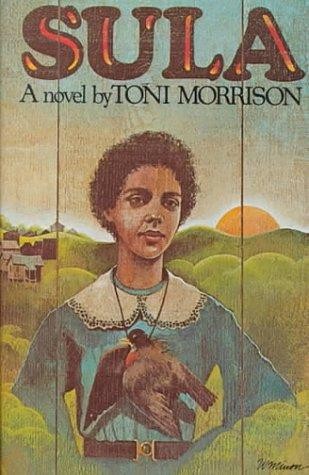
Sula
Toni Morrison (1973)
“A story about two Black women who need each other to exist — and what happens to a person when their opposite disappears.”
Sula— Historical Context & Author Background
Author: Toni Morrison · Published 1973· Era: Contemporary·174 pages
Themes explored: friendship, identity, good-vs-evil, community, freedom, conformity, death, race
About Toni Morrison
Toni Morrison (1931-2019) was born Chloe Ardelia Wofford in Lorain, Ohio — a small industrial town on Lake Erie that deeply informs the Medallion/Bottom geography. She grew up in a family that told ghost stories as fact and believed in the presence of the supernatural in everyday life. After graduating from Howard and Cornell, she worked as an editor at Random House while raising two sons alone — editing Sula during the same years she was supporting other Black writers. She published Sula in 1973 as her second novel, having published The Bluest Eye in 1970. It was nominated for the National Book Award. Morrison received the Nobel Prize in Literature in 1993.
Life → Text Connections
How Toni Morrison's real experiences shaped specific elements of Sula.
Morrison grew up in Lorain, Ohio, a small town with a defined Black community living adjacent to white economic power
The Bottom — a Black community on the hillside above Medallion, named through white deception, living in the leftovers of white geography
The Bottom is a portrait of the communities Morrison knew — not pathologized or romanticized, but given the full complexity of a world with its own myths, its own hierarchies, its own logic.
Morrison was a single mother editing books and raising children, working on Sula at night
The novel's portraits of women who build lives without reliable male partners — Eva, Hannah, Nel after Jude leaves, Sula by choice
Morrison wrote Sula from inside the experience of female self-sufficiency, and it shows. Eva and Sula's radical autonomy are not fantasies but worked-out philosophies.
Morrison's family placed high value on Black oral tradition, storytelling, and the presence of the spiritual in the everyday
The Bottom's mythology (the founding story, Eva's leg, Shadrack's ritual), Morrison's mythic narrative register
Sula is structured like oral tradition — dates as chapter titles, events circling back, the community as narrator. The form reflects the world it describes.
Historical Era
1919-1965 — Jim Crow North, Great Migration, WWII, Civil Rights era
How the Era Shapes the Book
The Bottom's history from 1919 to 1965 maps directly onto the trajectory of Black northern communities in the 20th century: World War I veterans returning shell-shocked to limited opportunity (Shadrack); the Great Depression's devastation of already-marginal communities; Black workers excluded from New Deal jobs (the tunnel that Jude Greene cannot get work building); urban renewal erasing the community that survived all of this. The novel's tragic ending — the golf course replacing the Bottom — is not metaphor. It is history.
Why Sula Matters Historically
Sula was one of the first novels by a Black woman to treat Black female friendship — not romance, not family, but friendship between women — as the primary subject worthy of literary attention. Morrison refused the tradition of the novel's plot organizing around male characters or heterosexual love. Nel and Sula's friendship IS the novel. This was, in 1973, a formal argument as much as a thematic one.
- One of the first major American novels to center Black female friendship as the primary narrative relationship
- First sustained literary treatment of the Black community as a full moral and philosophical world — not as background for white characters, not as victim, not as problem, but as a complete civilization with its own logic
- Morrison's development of the communal narrator — the 'we' of the Bottom — that she will perfect in Beloved
Challenged in schools for explicit sexual content, including a scene of voyeurism in childhood and the frank portrayal of Hannah Peace's sexuality. Also challenged for 'nihilism' and for portraying a community without offering clear moral resolution.