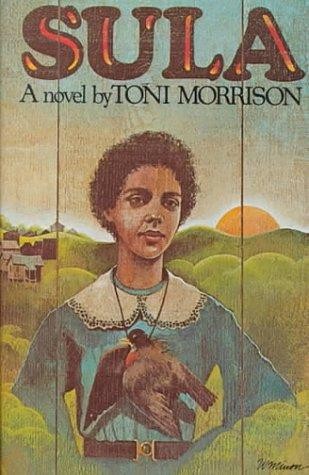
Sula
Toni Morrison (1973)
“A story about two Black women who need each other to exist — and what happens to a person when their opposite disappears.”
Language Register
Formal narrative voice with deep roots in Black vernacular speech — Morrison moves between elevated prose poetry and the idiom of the Bottom without signaling the shift
Syntax Profile
Morrison's sentences are long and subordinated in mythic/narrative passages, compressed and flat in moments of trauma. She withholds subjects and delays verbs — the syntax performs the Bottom's community consciousness. Dialogue is spare and vernacular; the most important conversations are short. Morrison trusts the weight of what is not said.
Figurative Language
High — but differently distributed than Fitzgerald. Morrison's metaphors tend to be embodied (the dirty gray ball, Eva's missing leg, the birthmark) rather than landscape-based. Symbolic geography (the Bottom, the river, the tunnel) carries ideological weight. Morrison rarely explains her symbols; they accumulate meaning through repetition.
Era-Specific Language
The Black hillside community — named through a white man's deception, converted into identity
Morrison's term for women who want partnership without ownership — Ajax's preferred type
Shadrack's ritual — January 3rd, when all death is acknowledged and therefore contained
Three unrelated boys in Eva's house, all named Dewey, who merge into a single indistinguishable unit
Morrison's image for Nel's grief — not colorful, not named, just present and gray
How Characters Speak — Class & Identity
Helene Wright
Formal, precise, erasure of any vernacular trace — her speech is the performance of propriety
Class aspiration as self-destruction. Helene is Morrison's portrait of respectability politics — the cost it extracts from Black women who pay it.
Eva Peace
Vernacular, declarative, no hedging — Eva speaks as someone who has already decided everything and needs no validation
Authority without class. Eva's power comes from will, not money or education. Her language reflects a woman who has survived everything and fears nothing.
Sula
Direct, unnerving — she says what others only think. Her most devastating lines are questions, not statements.
The radical individual has no social script to perform. Sula speaks from outside the community's consensus and therefore sounds like danger.
Nel
Polite, measured, increasingly self-suppressing — she speaks in the idiom of the good woman, which is also the idiom of erasure
Nel's language is her conformity made audible. The moment she finally screams — 'O Lord, Sula' — is the moment she speaks outside convention for the first time.
Shadrack
Sparse to the point of silence — his one word to Sula ('always') is his most complete sentence
Trauma as language-loss. Shadrack has lost the ability to speak in social registers; he can only speak in ritual. 'Always' is sufficient.
Narrator's Voice
Morrison's narrator is omniscient but communal — it speaks with the authority of collective memory, of the Bottom's oral tradition. It does not judge characters; it renders them with the fullness of people who are both their circumstances and more than their circumstances. When the narrator editorializes, it does so as a member of the community, not as a god above it.
Tone Progression
1919-1921
Mythic, establishing, folkloric
The Bottom is introduced as a place with a creation story. Shadrack and Eva are established as larger-than-life community anchors. The prose has the cadence of a tale told many times.
1922-1927
Intimate, elegiac, charged with contingency
The friendship chapters. The prose warms to the bodies and inner lives of Nel and Sula. The Chicken Little drowning arrives in flat, clipped sentences — then the intimacy resumes, deepening by what it refuses to discuss.
1937-1941
Communal, diagnostic, tragic
The community's response to Sula's return is rendered in the collective voice. The prose hardens as Sula deteriorates and the Bottom unravels. The tunnel collapse is written with documentary speed.
1965 coda
Bare, direct, heartbroken
All mythic distance collapses. The final pages are Morrison's most unguarded — Nel's grief is stated plainly because it can bear no ornament.
Stylistic Comparisons
- Beloved — Morrison's own later work, mythic community memory, trauma rendered without protective narrative distance
- Their Eyes Were Watching God (Hurston) — Black female selfhood and community, vernacular precision, the tension between freedom and belonging
- Song of Solomon (Morrison) — the Bottom's symbolic geography mirrors Milkman's landscape, community as protagonist
Key Vocabulary from This Book
Notable words used in this text — click to see full definitions