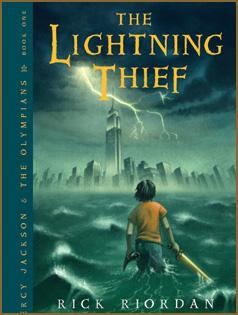
The Lightning Thief
Rick Riordan (2005)
“A boy with ADHD and dyslexia discovers his disabilities are actually the marks of a Greek demigod — and that someone has stolen Zeus's lightning bolt.”
This page prints on a single page. Use Ctrl+P / Cmd+P.
The Lightning Thief
Rick Riordan (2005) · 377pages · Contemporary Young Adult
Summary
Twelve-year-old Percy Jackson, expelled from every school he's attended, discovers he is the son of Poseidon — a Greek demigod whose ADHD and dyslexia are actually battle reflexes and an affinity for Ancient Greek. When Zeus's master lightning bolt is stolen and Percy is blamed, he must journey across America with Annabeth Chase and the satyr Grover Underwood to reach the Underworld, find the bolt, and prevent a war among the Olympian gods. Along the way, Percy confronts Medusa, Ares, Procrustes, and the treachery of Luke Castellan, ultimately returning the bolt to Zeus on the summer solstice and averting divine catastrophe.
Why It Matters
The Lightning Thief launched the Percy Jackson and the Olympians series (45+ million copies sold, 37 languages), which in turn spawned The Heroes of Olympus, The Trials of Apollo, The Kane Chronicles, and Magnus Chase — collectively known as the Riordanverse. More significantly, the novel fundame...
Themes & Motifs
Diction & Style
Register: Deliberately informal — first-person present-tense narration mimicking a twelve-year-old's natural speech patterns, with occasional shifts into mythological register for Oracle prophecies and divine encounters
Narrator: Percy Jackson: immediate, confessional, humorous under pressure. Percy addresses the reader directly and frequently b...
Figurative Language: Moderate
Historical Context
Early 2000s America — post-9/11, Iraq War, No Child Left Behind education policy, rise of standardized testing: The Lightning Thief arrived at a cultural moment when children's literacy was simultaneously a national priority (No Child Left Behind) and a national crisis (declining reading rates among boys). R...
Key Characters
Talking Points
- Riordan reframes ADHD as 'battlefield reflexes' and dyslexia as 'a brain hardwired for Ancient Greek.' Is this metaphor empowering, simplistic, or both? What are the limits of turning disability into superpower?
- Why does Riordan choose first-person narration for Percy rather than third-person? What would the novel lose if we could see inside Annabeth's or Luke's minds?
- Compare Camp Half-Blood to Hogwarts. Both are hidden sanctuaries for gifted children sorted by parentage. What does Camp Half-Blood offer that Hogwarts doesn't — and what does it lack?
- The gods in this novel are powerful but deeply flawed — petty, jealous, neglectful. Why doesn't Riordan make them straightforwardly good or evil? What does their moral complexity add to the story?
- Luke's argument against the gods is compelling: they abandon their children, they are petty and selfish, they send mortals to die in their wars. Why does Percy reject Luke's conclusion even though he agrees with Luke's evidence?
Why Read This
Because Percy Jackson is the kid who was told he was broken, and the novel proves the world was wrong. If you have ever sat in a classroom feeling like your brain works differently from everyone else's, this book was written for you — literally, f...