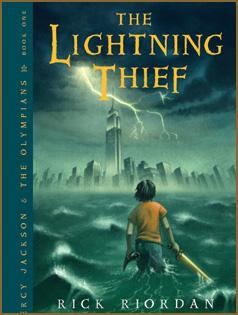
The Lightning Thief
Rick Riordan (2005)
“A boy with ADHD and dyslexia discovers his disabilities are actually the marks of a Greek demigod — and that someone has stolen Zeus's lightning bolt.”
Essay Questions & Food for Thought
30questions designed to challenge assumptions and provoke original thinking. These can't be answered from a summary — you need the actual text.
Riordan reframes ADHD as 'battlefield reflexes' and dyslexia as 'a brain hardwired for Ancient Greek.' Is this metaphor empowering, simplistic, or both? What are the limits of turning disability into superpower?
Why does Riordan choose first-person narration for Percy rather than third-person? What would the novel lose if we could see inside Annabeth's or Luke's minds?
Compare Camp Half-Blood to Hogwarts. Both are hidden sanctuaries for gifted children sorted by parentage. What does Camp Half-Blood offer that Hogwarts doesn't — and what does it lack?
The gods in this novel are powerful but deeply flawed — petty, jealous, neglectful. Why doesn't Riordan make them straightforwardly good or evil? What does their moral complexity add to the story?
Luke's argument against the gods is compelling: they abandon their children, they are petty and selfish, they send mortals to die in their wars. Why does Percy reject Luke's conclusion even though he agrees with Luke's evidence?
Sally Jackson married an abusive man to protect Percy from monsters. Is this heroism, self-destruction, or both? How does Riordan avoid making her a passive victim?
The Lightning Thief parallels Homer's Odyssey — the westward journey, the Lotus Eaters, Circe-like temptations, the descent to the Underworld. Why does Riordan make this structure explicit rather than subtle?
Percy mails Medusa's head to Mount Olympus with a sarcastic note. This is both brave and foolish. What does this moment reveal about Percy's relationship with authority?
The Mist prevents mortals from seeing the mythological world. What is Riordan saying about perception, denial, and the stories societies refuse to acknowledge?
Poseidon tells Percy 'I am proud of you' but cannot offer more. Is this enough? Does the novel think it should be? What does Percy's reaction tell us?
The novel was written for Riordan's dyslexic son. How does knowing this origin story change your reading? Does authorial intention matter, or does the text stand on its own?
Procrustes the Stretcher — who forces people to fit his beds by cutting or stretching them — is a metaphor for what? Where do we encounter 'Procrustean' systems in education and society?
Every demigod at Camp Half-Blood has an absent divine parent. How does the novel treat parental abandonment — as tragedy, as the necessary condition for heroism, or as both?
The novel locates Mount Olympus above the Empire State Building and the Underworld entrance in Los Angeles. Why these locations? What does the geography say about how mythology maps onto American culture?
Grover's quest to find the god Pan — the lost god of nature — runs parallel to Percy's quest. What does Pan's disappearance represent, and why does Riordan embed an environmental theme inside a mythology adventure?
Riordan reimagines World War II as a conflict among children of the Big Three gods. Is this a brilliant mythological conceit, a trivialization of real history, or something more complex?
The Lotus Casino traps people in timeless pleasure. Compare this to modern technologies designed to maximize engagement — social media feeds, streaming autoplay, mobile games. Is the Lotus Casino already real?
Percy defeats Ares not through superior strength but through proximity to the ocean. What does this say about the novel's definition of power? Is power inherent or situational?
The Oracle's prophecy warns Percy he will 'fail to save what matters most.' He interprets this as his mother. What does he actually fail to save, and how does the prophecy's ambiguity function narratively?
Why does Riordan make his gods speak in different registers — Ares crude, Poseidon restrained, Zeus imperious? How does divine speech reflect divine nature?
Compare The Lightning Thief to the original myth of Perseus (the hero Percy is named after). What does Riordan keep, what does he change, and what do the changes reveal about modern values?
The novel suggests that the unclaimed children at Camp Half-Blood — kids whose godly parents never acknowledged them — suffer most. What is Riordan saying about recognition and its absence?
Riordan's prose is deliberately simple — short sentences, common vocabulary, a twelve-year-old's voice. Is this a literary weakness or a deliberate artistic choice? Can 'simple' prose be sophisticated?
The Lightning Thief has been challenged in schools for promoting 'paganism.' How does the novel actually treat Greek religion? Is it promoting belief, or using mythology as metaphor?
Percy's fatal flaw is identified as loyalty — he will sacrifice the world to save a friend. How can loyalty be a flaw? When does the virtue of loyalty become dangerous?
Compare Luke Castellan to Draco Malfoy. Both are antagonists shaped by family dysfunction. Which is the more sympathetic villain, and what does each author's treatment of their antagonist reveal about their moral framework?
The novel ends with the immediate crisis resolved but the larger threat — Kronos — looming. How does this 'win the battle, lose the war' structure serve both the narrative and the series?
Annabeth says her fatal flaw is hubris — deadly pride. Where do you see hubris operating in the novel, and how does it differ from Percy's loyalty as a flaw?
Riordan went on to create series based on Roman, Egyptian, and Norse mythology, often with diverse protagonists. How does The Lightning Thief lay the groundwork for a multicultural mythological universe?
The Lightning Thief has sold over 45 million copies and been adapted into films and a Disney+ series. What about this particular novel — not just any children's fantasy — explains its extraordinary cultural reach?