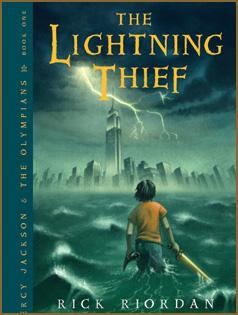
The Lightning Thief
Rick Riordan (2005)
“A boy with ADHD and dyslexia discovers his disabilities are actually the marks of a Greek demigod — and that someone has stolen Zeus's lightning bolt.”
The Lightning Thief— Historical Context & Author Background
Author: Rick Riordan · Published 2005· Era: Contemporary Young Adult·377 pages
Themes explored: identity, mythology, family, belonging, heroism, dyslexia-as-gift, father-son
About Rick Riordan
Rick Riordan (b. 1964) was a middle-school English and history teacher in San Antonio, Texas, for fifteen years before becoming a full-time novelist. He created Percy Jackson as a bedtime story for his son Haley, who has ADHD and dyslexia and was struggling in school. Haley loved Greek mythology — the one subject that engaged him — and asked his father to tell longer stories about the Greek gods. Riordan invented Percy as a demigod whose disabilities were divine gifts, and when the bedtime story ran out, Haley asked him to write it down. The novel was published in 2005 and launched the most successful mythology-based children's series in publishing history.
Life → Text Connections
How Rick Riordan's real experiences shaped specific elements of The Lightning Thief.
Riordan's son Haley has ADHD and dyslexia and was struggling to engage with school reading
Percy's ADHD and dyslexia are reframed as demigod traits — battle reflexes and a brain wired for Ancient Greek
The novel was literally written to help one dyslexic child see himself as heroic. It ended up doing the same for millions.
Riordan taught middle-school mythology for fifteen years and watched which stories captivated struggling readers
The novel deploys Greek myths with a teacher's precision — each monster encounter teaches classical mythology while advancing the plot
Riordan's classroom experience shaped every pedagogical decision. The novel teaches mythology the way a great teacher does: through story, not lecture.
Riordan observed that students labeled 'problem kids' often possessed extraordinary creativity and resilience
Camp Half-Blood is populated by children who failed in the mortal world but thrive in the mythological one
The novel argues that the fault lies with institutions, not children — a position Riordan developed through years of watching schools fail their most interesting students.
Riordan is a former award-winning mystery novelist (the Tres Navarre series) who brought genre-fiction pacing to children's literature
The Lightning Thief's plot moves at thriller pace — short chapters, constant escalation, cliffhanger endings
The pacing is not accidental but crafted by a writer who understood that reluctant readers need narrative momentum more than literary atmosphere.
Historical Era
Early 2000s America — post-9/11, Iraq War, No Child Left Behind education policy, rise of standardized testing
How the Era Shapes the Book
The Lightning Thief arrived at a cultural moment when children's literacy was simultaneously a national priority (No Child Left Behind) and a national crisis (declining reading rates among boys). Riordan's novel — fast-paced, mythology-rich, protagonist with learning disabilities — addressed both problems simultaneously. The post-Harry Potter publishing landscape was hungry for the next fantasy series, and Percy Jackson filled the demand while offering something Rowling's series did not: a protagonist whose neurological differences were central rather than incidental to his heroism.
Why The Lightning Thief Matters Historically
The Lightning Thief launched the Percy Jackson and the Olympians series (45+ million copies sold, 37 languages), which in turn spawned The Heroes of Olympus, The Trials of Apollo, The Kane Chronicles, and Magnus Chase — collectively known as the Riordanverse. More significantly, the novel fundamentally changed how children's literature treats learning disabilities, transforming ADHD and dyslexia from narrative obstacles into narrative assets. Libraries and educators report that the series is consistently the first book many reluctant readers finish voluntarily.
- First major children's series to make a protagonist's learning disabilities central to his heroic identity rather than obstacles to overcome
- Pioneered the modern 'mythology-in-the-real-world' genre that spawned dozens of imitators across multiple mythological traditions
- One of the first children's novels to successfully structure a modern narrative as a direct parallel to the Odyssey without requiring readers to know the source material
Challenged in some schools and libraries for promoting 'paganism' and polytheistic religion, and for violence. Also challenged for undermining parental authority (the gods are portrayed as neglectful parents). These challenges are relatively infrequent compared to other frequently banned books.