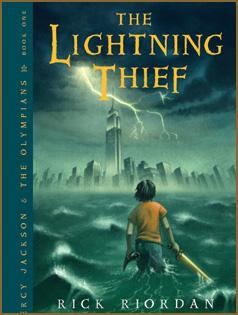
The Lightning Thief
Rick Riordan (2005)
“A boy with ADHD and dyslexia discovers his disabilities are actually the marks of a Greek demigod — and that someone has stolen Zeus's lightning bolt.”
Language Register
Deliberately informal — first-person present-tense narration mimicking a twelve-year-old's natural speech patterns, with occasional shifts into mythological register for Oracle prophecies and divine encounters
Syntax Profile
Short, declarative sentences averaging 10-15 words. Heavy use of first-person parenthetical asides ('Which was kind of cool, except for the part where I almost died'). Sentence fragments used for comic timing and emphasis. The syntax mimics ADHD thought patterns — associative, digressive, circling back to the main point after tangents. Dialogue is natural and contemporary, with no character speaking in an elevated register except the Oracle.
Figurative Language
Moderate — Riordan uses simile more than metaphor, grounding comparisons in a twelve-year-old's frame of reference ('like a Macy's Thanksgiving Day Parade balloon' rather than literary allusion). Mythological imagery is always filtered through Percy's modern sensibility, creating a comic-serious hybrid register.
Era-Specific Language
Demigod — child of one divine and one mortal parent. The term itself carries the stigma of being 'half' of something, never fully belonging to either world
The metal of divine weapons, lethal to monsters and immortals but passing harmlessly through mortals — a physical manifestation of the two-world divide
A supernatural veil that prevents mortals from perceiving the mythological world — Riordan's explanation for why modern humans don't see gods and monsters
Used only by Luke sarcastically — a deliberate echo that marks his cynicism toward heroic traditions
The golden blood of the gods, used in classical mythology — Riordan preserves the original Greek term to anchor his modern retelling in its source material
How Characters Speak — Class & Identity
Percy Jackson
Colloquial, self-deprecating, heavy on sarcasm and understatement. Frequent pop-culture references. Simple vocabulary deployed with unexpected precision.
A working-class kid from Manhattan's Upper East Side whose intelligence expresses itself through humor and observation, not academic language.
Annabeth Chase
More precise vocabulary, strategic phrasing, occasional lecturing tone. Uses mythological terminology comfortably.
Athena's daughter — intelligence is her birthright and her armor. Her language compensates for the emotional vulnerability she hides.
Luke Castellan
The most articulate speaker in the novel. Measured, persuasive, rhetorically sophisticated. His betrayal speech is the novel's most complex dialogue.
Luke is the camp's most experienced warrior and its most dangerous ideologue. His eloquence makes his rebellion credible.
The Gods (Zeus, Poseidon, Ares)
Formal, declarative, brooking no contradiction. Ares uses crude modern slang; Poseidon is measured and distant; Zeus is imperious.
Each god's speech reflects their domain — war is blunt, the sea is deep and restrained, the sky commands.
Narrator's Voice
Percy Jackson: immediate, confessional, humorous under pressure. Percy addresses the reader directly and frequently breaks the fourth wall, creating an intimacy that makes the mythological stakes feel personal. His voice is the novel's primary achievement — warm enough to sustain a child reader's trust, sharp enough to carry genuine emotional weight.
Tone Progression
Chapters 1-5
Bewildered, vulnerable, increasingly angry
Percy discovers the mythological world and processes the loss of his mother. Humor masks genuine fear.
Chapters 6-14
Determined, adventurous, darkly comic
The quest provides structure. Percy grows into his abilities. The humor becomes braver as the dangers escalate.
Chapters 15-22
Resolute, grieving, cautiously hopeful
The revelations about Ares, Luke, and Kronos strip away innocence. Percy's voice matures measurably — shorter sentences, less deflection.
Stylistic Comparisons
- J.K. Rowling's Harry Potter — similar hidden-world structure and school-as-sanctuary, but Percy's voice is more colloquial and self-aware than Harry's
- Suzanne Collins's The Hunger Games — shares the first-person urgency but Collins is grimmer, less humorous
- Lloyd Alexander's Chronicles of Prydain — earlier children's fantasy drawing on Welsh mythology with similar coming-of-age structure
- Homer's Odyssey — the explicit structural model, with each monster encounter paralleling a classical episode
Key Vocabulary from This Book
Notable words used in this text — click to see full definitions