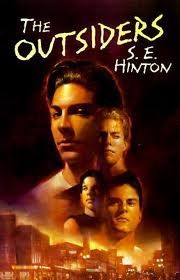
The Outsiders
S.E. Hinton (1967)
“Written by a 16-year-old about teenagers killing teenagers — and the book that proved young adult fiction could be real literature.”
Essay Questions & Food for Thought
30questions designed to challenge assumptions and provoke original thinking. These can't be answered from a summary — you need the actual text.
Ponyboy says he is 'inclined to tell people things' — yet he withholds things from himself throughout the novel, refusing to acknowledge that Johnny and Dally are dead. What is the difference between telling others and telling yourself the truth? Is Ponyboy an honest narrator?
The novel was written by a 16-year-old girl who published under male initials so boys would read it. How does knowing this change your reading of Ponyboy's voice? Does it make the novel more or less credible as a portrait of teenage masculinity?
Cherry Valance tells Ponyboy 'things are rough all over.' Is she right? Is there a meaningful difference between Cherry's problems and Ponyboy's problems, even if both are real?
The Frost poem 'Nothing Gold Can Stay' contains the line 'So Eden sank to grief.' How is The Outsiders a story about a fall from innocence? What is the 'Eden' each major character has already lost or is about to lose?
Darry hit Ponyboy once. Ponyboy never fully forgives him, yet the novel argues that Darry is a good person making impossible choices. Can both things be true? Does the novel ask us to forgive Darry?
The novel ends with Ponyboy writing its first line. The story is circular — it ends where it began. What is the effect of this structure? What does it mean that the novel we've been reading is Ponyboy's English theme?
Dally arranges his own death by running at the police with an unloaded gun. This is often read as suicide by cop. Why can't Dally survive Johnny's death? What does Johnny represent for Dally that nothing else can replace?
Bob Sheldon is killed in a self-defense situation, but he is never given a full scene from his own perspective. Is this a flaw in the novel, or does Hinton deliberately limit him? What is lost and gained by seeing Bob only through others' eyes?
The greasers win the rumble. Does it change anything? Randy Anderson said it wouldn't. Was he right? Why does Ponyboy go to the rumble even though he knows Randy is right?
Compare Ponyboy's relationship with books and poetry to his identity as a greaser. How does his literary sensitivity complicate the world's categorization of him? Is it radical, in 1967 or now, for a working-class teenager to love Robert Frost?
Johnny's parents don't come to the hospital until the very end, and even then his mother is performing distress rather than feeling it. How does the novel use absent and failed parents to explain who the gang becomes to each other?
S.E. Hinton wrote under male initials because her publisher feared boys wouldn't read a book written by a woman. Today her name is fully known. Does it matter that Hinton is a woman? Should it?
Cherry Valance says she can see Dally in a way that makes her afraid she could fall in love with him. What does she see? And why does danger attract people who have everything?
The fire at the church is the novel's turning point. Before the fire, Ponyboy and Johnny are fugitives. After the fire, they are heroes. Does the fire actually change who they are — or does it change who gets to see who they were?
Gone with the Wind is a novel about the destruction of an old social order — the antebellum South. Why does Hinton have Johnny and Ponyboy read it in the church? What is the connection between Scarlett O'Hara's world and Ponyboy's?
The title of the novel is 'The Outsiders.' Who exactly is an outsider in this book? The greasers feel like outsiders. But do the Socs — despite their money and status — also feel like outsiders in any sense? Does Cherry?
How would The Outsiders be different if it were written today? What would the class markers be? What would the equivalent of greaser hair and madras shirts look like in 2026? Would the class wall be harder or easier to see?
Hinton gives the greasers names like Ponyboy, Sodapop, Two-Bit, and Dally. The Socs have names like Bob, Randy, and Cherry. What does the naming system tell us about how each group sees itself and how each group is seen?
Sodapop drops out of school to help the family financially, and Hinton presents this as a tragedy without saying it's a tragedy. How does the novel use what characters DON'T say to convey loss?
The police shoot Dally dead in the street. No one faces consequences for this — not in the novel, not in the subsequent text. Is this a narrative choice by Hinton, or a reflection of the novel's understanding of how justice works for people like Dally?
Compare Dally to a tragic hero in the classical tradition. Does he have a hamartia (fatal flaw)? Or is he simply a person destroyed by forces external to himself, from the time he was a child?
The novel was challenged and banned in multiple school districts for violence and drug use. Given that the novel depicts violence as a product of poverty and class injustice rather than glamorizing it, what does it mean that the schools serving working-class students were the ones banning it?
Johnny tells Ponyboy to 'tell Dally' that there is still good in the world. But Dally is already dead when Ponyboy reads the note. Who is the message actually for? How does Hinton redirect it?
Two-Bit Mathews and Steve Randle are in the gang but remain relatively undeveloped as characters. Is this a flaw? Or does their presence as background characters serve a function in a novel about visibility and invisibility?
Compare The Outsiders to Romeo and Juliet. Both feature young people destroyed by a feud between social groups. How are Ponyboy and Johnny like Romeo and Juliet — and how is the class conflict more intractable than the Capulet-Montague feud?
The novel is set in Tulsa, Oklahoma, in the mid-1960s. The civil rights movement is barely mentioned. How do you read this absence? Is race invisible in this novel's class analysis — and is that a limitation of Hinton's vision or a reflection of Ponyboy's?
Ponyboy reads Gone with the Wind and loves it. The novel is a romanticization of the antebellum South — a society built on slavery. What does it mean that a working-class kid from 1960s Oklahoma identifies with Scarlett O'Hara? What might Hinton be saying about how the oppressed internalize the stories of the oppressor?
Darry gave up a college scholarship to raise his brothers. This is presented as heroic. But it is also presented as a tragedy. Can the same action be both heroic and tragic? What does the novel say about the sacrifices that class imposes?
The novel ends with Ponyboy's life mostly normalized: he passes his class, the brothers stay together, the gang continues. Is this a happy ending? What has been permanently lost that cannot be recovered by any normal routine?
S.E. Hinton has said she wrote The Outsiders because she wanted to read a book like it and none existed. What does it mean to write the book you needed and couldn't find? And what books do you need that don't exist yet?