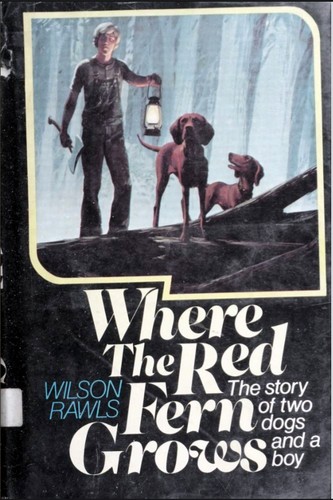
Where the Red Fern Grows
Wilson Rawls (1961)
“A boy, two dogs, and the Ozark wilderness — and the story of what loving something completely costs you.”
This page prints on a single page. Use Ctrl+P / Cmd+P.
Where the Red Fern Grows
Wilson Rawls (1961) · 249pages · Contemporary / Regional Realism
Summary
Ten-year-old Billy Colman desperately wants two coonhounds, saves two years of penny-by-penny earnings to buy them, and trains Old Dan and Little Ann in the Cherokee hunting grounds of the Oklahoma Ozarks. The dogs become legendary hunters. Billy wins the gold cup at a championship hunt. Then a mountain lion attacks, and Old Dan dies of his wounds. Little Ann, heartbroken, dies days later at Old Dan's grave. A red fern — a plant that Cherokee legend says only an angel can plant — grows up between their graves, a sign of their sacred bond.
Why It Matters
One of the bestselling middle-grade novels of the twentieth century — reliably in the top 100 most-assigned books in American middle schools. The novel's treatment of grief — direct, unsentimental, and fully honorable — distinguished it from most children's literature of its era and gave generati...
Themes & Motifs
Diction & Style
Register: Informal and direct — Ozark rural vernacular, simple declarative sentences, almost no literary decoration
Narrator: Billy Colman as adult, looking back at childhood. The retrospective frame gives the story emotional weight without ir...
Figurative Language: Very low. Rawls uses almost no metaphor or simile. When figurative language appears, it stands out precisely because it is rare. The red fern itself operates as a symbol, but Rawls never announces it as one
Historical Context
Early 1900s Oklahoma — Cherokee Nation territory, frontier-era Ozark culture: The novel's economic precision — Billy saving for two years, the father's exact knowledge of what he cannot afford — reflects real subsistence farming conditions. The Cherokee cultural elements (th...
Key Characters
Talking Points
- Billy saves for two years before his parents find out. Why does he keep the plan secret? Is this deceptive, or is it something else?
- Rawls opens the novel with adult Billy rather than with Billy's childhood. Why start at the end? What does the narrative frame accomplish that starting chronologically wouldn't?
- Billy refuses to kill the ghost coon even though he bet on a kill. What does this decision tell us about his moral code? Is he right?
- Why does Rawls give Old Dan courage and Little Ann intelligence rather than making both dogs equally skilled? What does their complementarity argue about partnerships?
- Billy weeps at Rubin Pritchard's funeral — for a boy who was trying to kill his dog. Is this realistic? What does it reveal about Billy's character?
Notable Quotes
“He was a big dog, a real big one. His coat was a dark red color, and his hair was short, thick, and gleaming.”
“I stood at the gate a long time after he had disappeared.”
“I had prayed for the dogs so long and so hard that Mama had given up trying to make me stop.”
Why Read This
Because no other book in the middle school canon teaches grief this honestly. Old Dan and Little Ann die, and the novel does not apologize for it or fix it. Billy carries the loss forward. So do you. That is the lesson, and no other genre delivers...