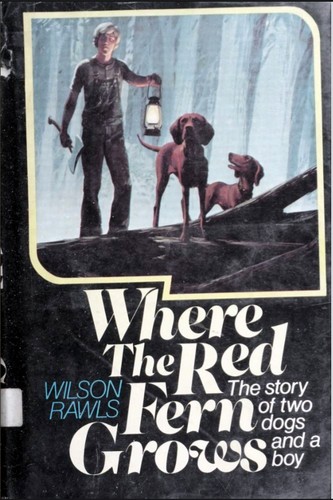
Where the Red Fern Grows
Wilson Rawls (1961)
“A boy, two dogs, and the Ozark wilderness — and the story of what loving something completely costs you.”
Where the Red Fern Grows— Historical Context & Author Background
Author: Wilson Rawls · Published 1961· Era: Contemporary / Regional Realism·249 pages
Themes explored: perseverance, loyalty, family, nature, loss, coming-of-age, determination, love
About Wilson Rawls
Wilson Rawls (1913-1984) grew up in a log cabin in the Ozark hills of Cherokee County, Oklahoma — the exact setting of the novel. His family was poor, he had no formal schooling until his teens, and he hunted with his own redbone hounds as a boy. He taught himself to read and write largely from a copy of the Bible and Jack London's Call of the Wild. He worked for decades as a carpenter and construction worker, writing and rewriting the story of his dogs in spare moments. He burned an early draft, certain it was worthless. His wife found the surviving draft, read it, and told him it had to be published. He was forty-eight when it appeared in 1961. It became one of the bestselling children's novels of the twentieth century.
Life → Text Connections
How Wilson Rawls's real experiences shaped specific elements of Where the Red Fern Grows.
Rawls grew up in exact poverty Billy describes — log cabin, subsistence farming, no money for extras
Every detail of the Colman family's economic life — the worn overalls, the tin can savings, the knowledge that dogs cannot be afforded
The poverty is not sentimentalized because Rawls lived it. He knew what it actually felt like to want something his family couldn't buy.
Rawls actually owned two redbone coonhounds and hunted with them in the Cherokee hills as a boy
Old Dan and Little Ann — their characters, their hunting methods, their relationship
The dogs are not imagined. Their personalities, their complementary strengths, and the grief of losing them are autobiographical. The novel is a forty-year-old act of mourning.
Rawls taught himself to write with no formal education, learning from the Bible and Jack London
The plain, direct prose style — simple sentences, concrete nouns, almost no figurative language
The prose style is not a literary choice but an honest accounting of what Rawls could do with the tools he had. Its simplicity is its authenticity.
Rawls burned an early draft before his wife found and saved the surviving version
The novel's emotional directness — no ironic distance, no literary self-consciousness, no protecting the author from exposure
A man who almost destroyed the only record of his deepest experience writes without armor. The rawness of the emotion is the courage of a writer who has nothing left to hide.
Historical Era
Early 1900s Oklahoma — Cherokee Nation territory, frontier-era Ozark culture
How the Era Shapes the Book
The novel's economic precision — Billy saving for two years, the father's exact knowledge of what he cannot afford — reflects real subsistence farming conditions. The Cherokee cultural elements (the legend of the red fern, the naming of the hills) reflect the survival of indigenous tradition under assimilation pressure. The landscape is not just beautiful Ozark scenery; it is Cherokee land, and Rawls knew this.
Why Where the Red Fern Grows Matters Historically
One of the bestselling middle-grade novels of the twentieth century — reliably in the top 100 most-assigned books in American middle schools. The novel's treatment of grief — direct, unsentimental, and fully honorable — distinguished it from most children's literature of its era and gave generations of young readers their first serious encounter with loss in fiction.
- One of the first widely-read children's novels to end with the death of beloved animals without softening, moralizing, or providing a compensatory rescue
- An early example of regional realism in children's literature — the specific Cherokee Ozark setting treated as culturally and historically significant rather than generic countryside
- One of the few middle-grade novels that is genuinely autobiographical — the story Rawls needed decades to be able to write
Challenged occasionally for the death of the dogs (deemed emotionally inappropriate for children) and for the death of Rubin Pritchard (violence). These challenges have never succeeded — the novel's emotional honesty is precisely what gives it its enduring educational value.