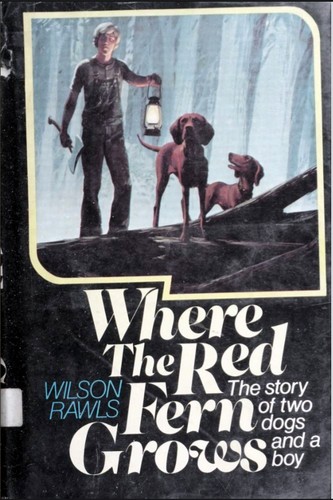
Where the Red Fern Grows
Wilson Rawls (1961)
“A boy, two dogs, and the Ozark wilderness — and the story of what loving something completely costs you.”
Language Register
Informal and direct — Ozark rural vernacular, simple declarative sentences, almost no literary decoration
Syntax Profile
Short, declarative sentences. Subject-verb-object. Rawls rarely uses subordinate clauses. His average sentence is under 15 words. Dialogue is minimal and functional. The prose never calls attention to itself — the point is always the event being described, not the description.
Figurative Language
Very low. Rawls uses almost no metaphor or simile. When figurative language appears, it stands out precisely because it is rare. The red fern itself operates as a symbol, but Rawls never announces it as one — he describes it, and the meaning accrues from context.
Era-Specific Language
A breed of dog bred specifically for tracking and treeing raccoons — the central activity of Ozark rural culture
To chase an animal until it climbs a tree and then signal its location by barking — the primary objective of a coon hunt
The specific howling sound a hound makes when on a scent or at a treed animal — distinct from barking, immediately recognizable to hunters
The strength of a scent: cold trail = old/faint; hot trail = fresh/strong. Indicates how recently the animal passed.
The northeastern Oklahoma Ozark region, historically Cherokee Nation territory — the novel's geographical and cultural anchor
How Characters Speak — Class & Identity
Billy Colman
Plain, direct, active-voice sentences. He reports what happens without interpretation. His emotional vocabulary is limited but not shallow — he describes physical sensations rather than internal states.
An Ozark farm boy's relationship to language: words are tools for communication, not performance. The plainness is dignity, not limitation.
Billy's Father
Minimal dialogue. Communicates through action. When he does speak, it is in short, practical sentences.
The stoic working farmer — love expressed through provision and presence, not speech. His emotional register is identical to Billy's, suggesting the son learned the language from the father.
Grandpa
Even more minimal than the father. Nods, smiles, acts. Rarely explains himself.
Wisdom expressed as economy. Grandpa says what is necessary and nothing more. This is not coldness — the warmth is in the actions, not the words.
Narrator's Voice
Billy Colman as adult, looking back at childhood. The retrospective frame gives the story emotional weight without irony — the adult Billy tells this story from love, not from disillusionment. Unlike Gatsby's Nick, who grows bitter, adult Billy grows tender.
Tone Progression
Chapters 1-5 (Sections 1-2)
Longing, determined, quietly joyful
The savings arc and the journey to Tahlequah. The prose is spare but warm. Billy's desire is honored as legitimate and serious.
Chapters 6-11 (Sections 3-5)
Confident, expansive, triumphant
Training, first hunts, the Pritchard episode, the championship. The prose is at its most active and forward-moving. Everything is building.
Chapters 12-16 (Sections 6-8)
Elegiac, plain, quietly devastated
The mountain lion, the deaths, the red fern. The prose slows, simplifies, and strips. Rawls removes decoration as the grief deepens.
Stylistic Comparisons
- John Steinbeck's Of Mice and Men — similar emotional plainness, similar willingness to give grief its full weight without softening
- Fred Gipson's Old Yeller — direct structural comparison: both are stories of a boy's relationship with a beloved dog that ends in death, both set in rural America
- Laura Ingalls Wilder's Little House series — similar regional specificity and matter-of-fact treatment of hardship as ordinary life
Key Vocabulary from This Book
Notable words used in this text — click to see full definitions