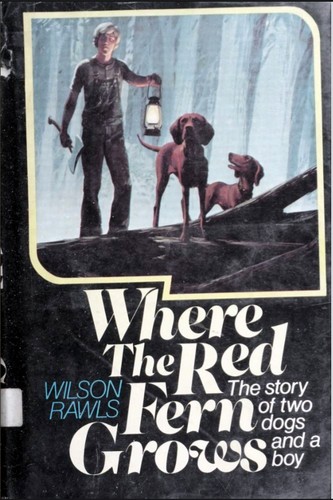
Where the Red Fern Grows
Wilson Rawls (1961)
“A boy, two dogs, and the Ozark wilderness — and the story of what loving something completely costs you.”
Where the Red Fern Grows— Summary & Analysis
by Wilson Rawls · published 1961 · 249 pages · Contemporary / Regional Realism
A user-friendly study guide for Where the Red Fern Grows by Wilson Rawls (1961): a high-level plot summary, full chapter-by-chapter analysis, theme breakdowns, character profiles, and 30 essay questions designed for middle-school, high-school readers. Unlike a stock summary, sumsumsum.com adds a diction analysis drawn from Wilson Rawls’s actual text, and reading-difficulty guidance (Easy, 1/10) so students, teachers, and lifelong readers know what they are walking into.
“A boy, two dogs, and the Ozark wilderness — and the story of what loving something completely costs you.”
Short Summary
Ten-year-old Billy Colman desperately wants two coonhounds, saves two years of penny-by-penny earnings to buy them, and trains Old Dan and Little Ann in the Cherokee hunting grounds of the Oklahoma Ozarks. The dogs become legendary hunters. Billy wins the gold cup at a championship hunt. Then a mountain lion attacks, and Old Dan dies of his wounds. Little Ann, heartbroken, dies days later at Old Dan's grave. A red fern — a plant that Cherokee legend says only an angel can plant — grows up between their graves, a sign of their sacred bond.
Detailed Summary
Billy Colman is ten years old in the early 1900s Ozark hills of northeastern Oklahoma, living miles from town with his parents and three younger sisters. He is desperately lonely and desperately wants two coonhounds — a pair, not one, because he believes two dogs together are stronger than two dogs ...
Summary in the Author’s Writing Style
A retelling of Where the Red Fern Grows in Wilson Rawls’s style — so you can hear the language, not just the plot. This is a stylistic pastiche written by sumsumsum, not an excerpt from the book.
I was ten years old that summer, and I wanted two coonhounds more than I had ever wanted anything. Not one dog. Two. I had it in my mind that two dogs were stronger together than they ever could be apart. My papa could not buy them. We lived far back in the Ozark hills, miles from town, and money wa…
Chapter-by-Chapter Analysis
If you liked Where the Red Fern Grows, read next
Start with Old Yeller by Fred Gipson — The most direct comparison — a boy's bond with a dog that ends in death, set in the rural American frontier. Old Yeller asks the boy to act; Red Fern asks Billy only to witness and survive.. Then try Of Mice and Men by John Steinbeck — Similar emotional plainness and similar refusal to soften grief. Both novels argue that the depth of love is measured by the depth of loss — and neither flinches from that cost.. Or pivot to Bridge to Terabithia by Katherine Paterson — Another foundational grief novel for young readers — sudden loss, a world transformed, and the question of what endures. Where Red Fern builds to its ending; Terabithia ambushes you..
For comparative essays, pair Where the Red Fern Grows with
The strongest comparative pairing is Sounder (William H. Armstrong) — Another novel about a dog and a boy in rural poverty, with the dog's decline as the emotional center. Sounder is bleaker and more explicitly political; Red Fern is more personal and more consoled.. For a third angle, contrast with The Call of the Wild (Jack London) — The book Rawls taught himself to read from. London's treatment of dogs as morally significant creatures is the direct literary ancestor of Rawls's approach..
Each of these pairings opens a clean thesis path on shared themes, period diction, or formal influence — useful for AP Lit / IB / first-year college comparative essays.