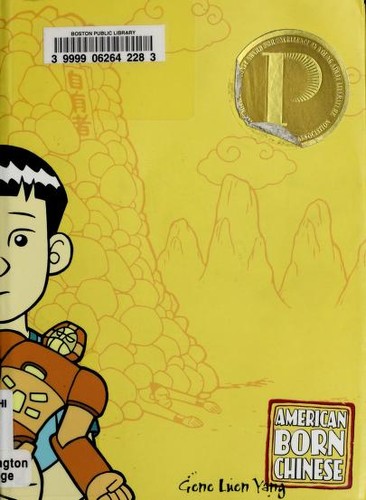
American Born Chinese
Gene Luen Yang (2006)
“Three stories about hiding who you are — a Chinese folk hero, a second-generation kid, and a sitcom nightmare — crash together in a twist that redefines all of them.”
At a Glance
Three seemingly separate stories interweave: the Monkey King, a deity who refuses to accept he is a monkey; Jin Wang, a Chinese American boy navigating white suburban middle school; and Danny, an all-American teen humiliated by annual visits from his grotesque Chinese cousin Chin-Kee. In a stunning convergence, the three strands reveal themselves as one story about shame, identity, and the cost of trying to be someone you are not. The Monkey King is Wei-Chen's father, Chin-Kee is the Monkey King in disguise, and Danny is actually Jin — who transformed himself to escape his Chineseness. Acceptance of self, the novel argues through both myth and realism, is the only path to wholeness.
Read full summary →Why This Book Matters
The first graphic novel to win the Michael L. Printz Award (2007) and the first to be nominated for a National Book Award (Young People's Literature, 2006). American Born Chinese shattered the perception that graphic novels were not 'real literature' and that Asian American stories were niche. It demonstrated that the graphic novel form could achieve the same thematic complexity as prose fiction — and in some cases, more, because racism operates through images and the medium can make that operation visible.
Diction Profile
Three distinct registers — mythic formality (Monkey King), naturalistic teen vernacular (Jin Wang), satirical sitcom (Danny/Chin-Kee) — that converge into direct emotional simplicity
Low in verbal text, extremely high in visual composition. The graphic novel form IS the figurative language