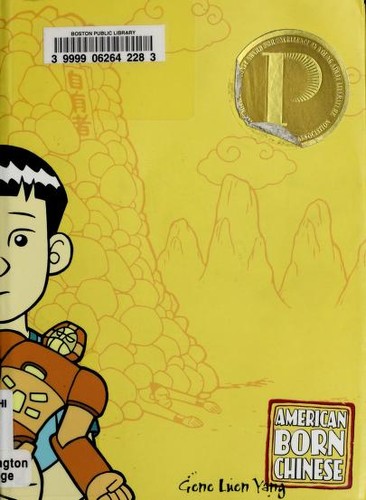
American Born Chinese
Gene Luen Yang (2006)
“Three stories about hiding who you are — a Chinese folk hero, a second-generation kid, and a sitcom nightmare — crash together in a twist that redefines all of them.”
This page prints on a single page. Use Ctrl+P / Cmd+P.
American Born Chinese
Gene Luen Yang (2006) · 233pages · Contemporary / 21st Century · 2 AP appearances
Summary
Three seemingly separate stories interweave: the Monkey King, a deity who refuses to accept he is a monkey; Jin Wang, a Chinese American boy navigating white suburban middle school; and Danny, an all-American teen humiliated by annual visits from his grotesque Chinese cousin Chin-Kee. In a stunning convergence, the three strands reveal themselves as one story about shame, identity, and the cost of trying to be someone you are not. The Monkey King is Wei-Chen's father, Chin-Kee is the Monkey King in disguise, and Danny is actually Jin — who transformed himself to escape his Chineseness. Acceptance of self, the novel argues through both myth and realism, is the only path to wholeness.
Why It Matters
The first graphic novel to win the Michael L. Printz Award (2007) and the first to be nominated for a National Book Award (Young People's Literature, 2006). American Born Chinese shattered the perception that graphic novels were not 'real literature' and that Asian American stories were niche. It...
Themes & Motifs
Diction & Style
Register: Three distinct registers — mythic formality (Monkey King), naturalistic teen vernacular (Jin Wang), satirical sitcom (Danny/Chin-Kee) — that converge into direct emotional simplicity
Narrator: No single narrator — the graphic novel shifts between third-person myth (Monkey King), close third / quasi-first-pers...
Figurative Language: Low in verbal text, extremely high in visual composition. The graphic novel form IS the figurative language
Historical Context
Late 20th / Early 21st century Asian American experience — post-1965 Immigration Act, model minority myth, post-9/11 racial anxiety: Yang wrote American Born Chinese in a moment when Asian American identity was simultaneously hypervisible (model minority stereotypes, kung fu movies, anime) and invisible (almost no literary repre...
Key Characters
Talking Points
- Why does Yang open the novel with the Monkey King rather than with Jin Wang? What does the mythological frame give the realistic story that it couldn't achieve on its own?
- Chin-Kee is deliberately drawn using racist caricature conventions from 19th-century anti-Chinese propaganda. Is this effective anti-racist critique, or does it risk reinforcing the stereotypes it claims to dismantle?
- The laugh track ('HA HA HA HA') appears throughout the Danny/Chin-Kee sections. What is Yang arguing about the relationship between humor and racism by making this visible on the page?
- The Monkey King begins wearing shoes after being humiliated by the gods. What do the shoes symbolize, and how does the act of removing them parallel Jin's story?
- Greg tells Jin not to date Amelia without ever explicitly mentioning race. How does Yang use the unfinished sentence as a technique for representing 'polite' racism?
Notable Quotes
“You may be a king — you may even be a deity — but you are still a monkey.”
“He now wore shoes.”
“My mommy says Chinese people eat dogs.”
Why Read This
Because it will make you uncomfortable, and the discomfort is the point. If you have ever felt ashamed of where you come from, who your parents are, or what you look like, this book sees you. If you haven't, it will show you what that shame feels ...