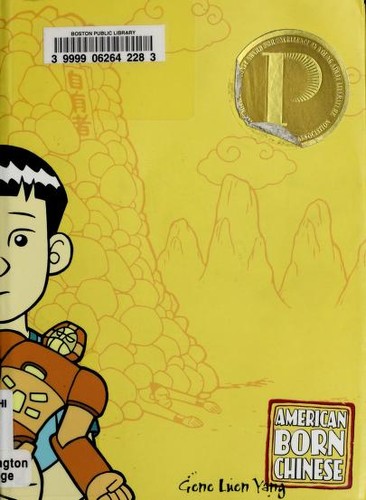
American Born Chinese
Gene Luen Yang (2006)
“Three stories about hiding who you are — a Chinese folk hero, a second-generation kid, and a sitcom nightmare — crash together in a twist that redefines all of them.”
Essay Questions & Food for Thought
30questions designed to challenge assumptions and provoke original thinking. These can't be answered from a summary — you need the actual text.
Why does Yang open the novel with the Monkey King rather than with Jin Wang? What does the mythological frame give the realistic story that it couldn't achieve on its own?
Chin-Kee is deliberately drawn using racist caricature conventions from 19th-century anti-Chinese propaganda. Is this effective anti-racist critique, or does it risk reinforcing the stereotypes it claims to dismantle?
The laugh track ('HA HA HA HA') appears throughout the Danny/Chin-Kee sections. What is Yang arguing about the relationship between humor and racism by making this visible on the page?
The Monkey King begins wearing shoes after being humiliated by the gods. What do the shoes symbolize, and how does the act of removing them parallel Jin's story?
Greg tells Jin not to date Amelia without ever explicitly mentioning race. How does Yang use the unfinished sentence as a technique for representing 'polite' racism?
Why does Jin reject Wei-Chen when they first meet? What does Jin's initial cruelty toward the one person who could understand him reveal about internalized racism?
Could American Born Chinese work as a prose novel? What specific arguments does the graphic novel form make that prose could not?
The Monkey King could free himself at any time by accepting he is a monkey. He refuses for five hundred years. What does this say about shame — and why is it harder to accept yourself than to fight the entire universe?
Yang is a Catholic writing about a Chinese Buddhist myth in the context of American racial identity. How does his syncretic approach to religion and culture mirror the novel's argument about hyphenated identity?
Compare the novel's ending — Jin and Wei-Chen at a boba tea shop, uncertain and quiet — to a conventional Hollywood reconciliation. Why does Yang choose ambiguity over resolution?
The herbalist tells young Jin he can be anything he wants 'but first you must forfeit your soul.' How does this prophecy play out literally and figuratively across the novel?
Why does Yang make Amelia genuinely likable rather than making her a shallow prize for Jin's affections? How does this complicate the novel's racial politics?
American Born Chinese is one of the most frequently banned books in America. The sections that cause bans are the Chin-Kee sections — the ones designed to critique racism. What does this tell us about how institutions handle uncomfortable art?
Wei-Chen's Transformer toy is revealed to be a divine artifact. Why does Yang choose a mass-market American toy as the vessel for Chinese divinity?
Compare the Monkey King's transformation (growing huge, mastering kung fu, declaring himself a god) to Jin's transformation (perm, dating white, becoming Danny). Both are responses to the same feeling. What differs?
How does the three-strand structure of the novel mimic the experience of fragmented identity? What does it feel like to read three disconnected stories, and how does that mirror what it feels like to live a divided life?
Danny's teacher never notices that Chin-Kee's behavior is abnormal. No adult intervenes. What is Yang saying about institutional failure in the face of racial harm?
Compare American Born Chinese to Maus by Art Spiegelman. Both use visual allegory (animals/caricature) to represent racial categories. How do their strategies differ, and what does each achieve?
The Monkey King's punishment comes from Tze-Yo-Tzuh, a creator deity. Is the novel arguing that identity is divinely assigned, personally chosen, or socially constructed? Can it be all three?
Jin kisses Suzy Nakamura — not out of desire but out of desperation. Why is this the act that destroys his friendship with Wei-Chen? What makes this betrayal worse than the perm or the distancing?
Yang has said that if Chin-Kee stops being funny and starts being painful, the novel is working. At what point did the Chin-Kee sections stop being funny for you, and what caused the shift?
How does the Disney+ adaptation (2023) change the novel's argument by extending the story and adding new characters? Does the adaptation gain or lose something in the translation from page to screen?
The novel's three strands could be read as: how racism feels from mythology (Monkey King), how it feels in daily life (Jin), and how it feels in media representation (Danny/Chin-Kee sitcom). Does this reading hold up? What does each strand capture that the others can't?
Jin's teacher introduces him as being 'from China' when he is from San Francisco. Why is this small mistake significant? What does it reveal about how Asian Americans are perceived regardless of their actual origins?
Compare Jin's experience to the current discourse around code-switching — the practice of changing behavior, speech, or appearance depending on social context. Is Jin code-switching or doing something more extreme?
Wong Lai-Tsao frees the Monkey King not through force or argument but through example — he is simply, visibly at peace with who he is. Why is witnessing self-acceptance in another person more powerful than being told to accept yourself?
The novel's color palette shifts dramatically between strands — warm golds for the Monkey King, muted suburban tones for Jin, garish primary colors for Chin-Kee. How does Yang use color as a narrative tool?
Wei-Chen fails his divine test because of Jin's betrayal. Is this fair? Should Wei-Chen's success depend on another person's choices?
Reread the novel after knowing the twist. How does the convergence change the meaning of specific panels and scenes you interpreted differently on first read?
The Monkey King tells Jin: 'I would have saved myself from five hundred years of imprisonment had I only realized how good it is to be a monkey.' Can this sentiment survive contact with the real world, where being yourself carries genuine social costs? Is the novel naive, or is it saying something harder than it appears?