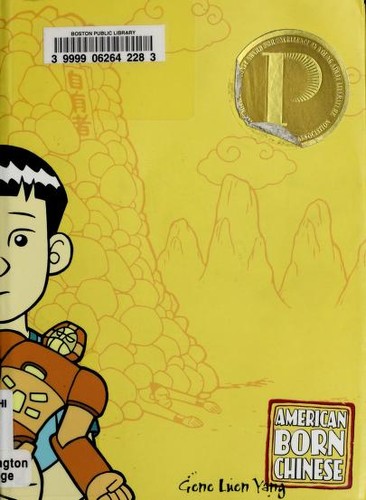
American Born Chinese
Gene Luen Yang (2006)
“Three stories about hiding who you are — a Chinese folk hero, a second-generation kid, and a sitcom nightmare — crash together in a twist that redefines all of them.”
Language Register
Three distinct registers — mythic formality (Monkey King), naturalistic teen vernacular (Jin Wang), satirical sitcom (Danny/Chin-Kee) — that converge into direct emotional simplicity
Syntax Profile
As a graphic novel, syntax operates on two registers simultaneously: verbal (dialogue and narration) and visual (panel composition, page layout, character design). Yang's verbal syntax varies by strand — the Monkey King sections use complex, formal sentences while Jin's sections use fragmented teen speech. The visual syntax is equally differentiated: mythic panels are symmetrical and bordered; school panels are mundane and regular; sitcom panels mimic television aspect ratios. The convergence collapses all three syntaxes into one.
Figurative Language
Low in verbal text, extremely high in visual composition. The graphic novel form IS the figurative language — Chin-Kee's face is a visual metaphor for internalized racism, the Monkey King's shoes are a visual metaphor for assimilation, and the three-strand structure is itself a metaphor for the fragmented identity of the hyphenated American.
Era-Specific Language
Taiwanese-originated bubble tea — marker of Asian American social spaces
'Fresh Off the Boat' — derogatory term for recent immigrants, internalized by Jin
1980s-2000s toy franchise — Wei-Chen's prized possession doubles as a divine artifact
Terms of false familiarity — Chin-Kee's 'cousin Da-nee' performs a kinship Danny wants to deny
Traditional title from Journey to the West — the Monkey King's self-proclaimed divinity masking shame
How Characters Speak — Class & Identity
Jin Wang
Standard American teen English — contractions, slang, fragments. No accent, no markers of foreignness.
Jin speaks 'unaccented' English because he has worked to erase every trace of difference. His linguistic assimilation is complete — which is precisely the problem.
Wei-Chen Sun
Slightly formal English with occasional grammatical slips — marks him as a recent immigrant learning the language.
Wei-Chen's imperfect English is authentic where Jin's perfect English is performative. The 'flaws' in Wei-Chen's speech are markers of honesty.
Chin-Kee
Extreme pidgin English with L/R substitutions — borrowed directly from yellowface performance traditions.
Chin-Kee's speech is not a representation of how any real person talks. It is a representation of how racists imagine Chinese people talk. The distinction is the novel's entire argument.
The Monkey King
Formal, declarative, mythic register — the language of folklore and parable.
The Monkey King speaks in the register of eternal truth, which gives his advice to Jin the weight of centuries rather than the authority of a single individual.
Danny
Generic suburban American teen — unremarkable, bland, deliberately without character.
Danny's blandness is the point. He is what Jin thinks 'normal' sounds like — a voice so default it has no identity, which is exactly what Jin sacrificed his identity to achieve.
Narrator's Voice
No single narrator — the graphic novel shifts between third-person myth (Monkey King), close third / quasi-first-person (Jin), and sitcom omniscience (Danny). Yang himself is the narrator through his visual choices: panel composition, character design, and page layout communicate what no character says aloud. The author's hand is most visible in the Chin-Kee sections, where the deliberate ugliness of the drawing style constitutes an authorial argument about representation.
Tone Progression
Opening Strands (Chapters 1-3)
Triptych: mythic wonder / naturalistic melancholy / satirical discomfort
Each strand establishes its own tonal world. The reader's experience is deliberately fragmented — three genres, three moods, no obvious connection.
Crisis Strands (Chapters 4-6)
Intensifying: theological gravity / social desperation / unbearable satire
All three strands tighten. The Monkey King's imprisonment darkens the myth. Jin's betrayals escalate. Chin-Kee becomes genuinely distressing. The reader feels the strands pulling toward each other.
Convergence and Resolution (Chapters 7-8)
Revelatory, then quiet
The convergence is explosive — identities revealed, structures collapsed. The final chapter is the stillest in the book: warm, uncertain, human. The loudness resolves into a whisper.
Stylistic Comparisons
- Maus by Art Spiegelman — graphic novel using animal metaphors for race; both use visual allegory to make racism literal on the page
- Persepolis by Marjane Satrapi — graphic memoir of cultural displacement; similar navigation of dual identity through sequential art
- The Joy Luck Club by Amy Tan — generational Chinese American identity; Yang does in images what Tan does in interlocking narratives
- Journey to the West (Wu Cheng'en) — the source text for the Monkey King strand; Yang transforms religious allegory into immigration parable
Key Vocabulary from This Book
Notable words used in this text — click to see full definitions