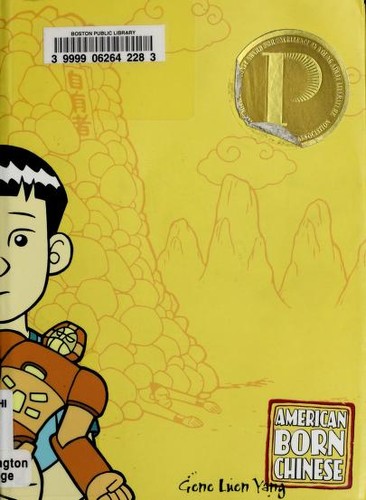
American Born Chinese
Gene Luen Yang (2006)
“Three stories about hiding who you are — a Chinese folk hero, a second-generation kid, and a sitcom nightmare — crash together in a twist that redefines all of them.”
American Born Chinese— Historical Context & Author Background
Author: Gene Luen Yang · Published 2006· Era: Contemporary / 21st Century·233 pages
Themes explored: identity, assimilation, stereotypes, self-acceptance, transformation, shame, racism
About Gene Luen Yang
Gene Luen Yang was born in 1973 in Alameda, California, to Chinese immigrant parents. He grew up navigating the space between his parents' Chinese culture and suburban American life — an experience that maps directly onto Jin Wang's story. Yang studied computer science at UC Berkeley and became a high school computer science teacher, writing comics on the side. American Born Chinese began as his MFA thesis project at Hamline University. He has spoken extensively about growing up ashamed of his Chinese heritage and the long process of self-acceptance that the novel dramatizes. A devout Catholic, Yang layers Christian theological concepts onto the Chinese mythological framework of the Monkey King story, creating a syncretic spiritual argument about identity and grace. He was appointed the National Ambassador for Young People's Literature by the Library of Congress in 2016.
Life → Text Connections
How Gene Luen Yang's real experiences shaped specific elements of American Born Chinese.
Yang grew up as one of few Asian American students in a predominantly white school
Jin Wang's isolation in his suburban school — the only dark-haired figure in panels full of light-haired classmates
The visual isolation Yang draws is autobiographical. He has said that Jin's experience of being the only Asian kid in the room is his own experience, rendered in ink.
Yang has described childhood shame about his parents' accents, their food, the cultural markers that made his family visibly different
Jin's rejection of Wei-Chen, his perm, his attempts to erase every marker of Chineseness
The assimilation project is not abstract for Yang — it is memoir. His ability to render Jin's shame without judgment comes from having lived it.
Yang is a practicing Catholic who sees no contradiction between his faith and his Chinese cultural heritage
The syncretic theology of the Monkey King strand — Chinese Buddhist mythology filtered through a framework of grace, free will, and acceptance
Yang's religious faith gives the Monkey King strand its moral weight. The mountain is not punishment but grace — freedom was always available through acceptance.
Yang chose to write a graphic novel — a form often dismissed as unserious — about racial identity
The graphic novel form as argument: Chin-Kee's face MUST be drawn to be confronted; racism is visual, and the medium makes it visible
Yang's choice of form is inseparable from his argument. American Born Chinese could not work as prose because its central claim — that racism operates through images — requires images to prove.
Historical Era
Late 20th / Early 21st century Asian American experience — post-1965 Immigration Act, model minority myth, post-9/11 racial anxiety
How the Era Shapes the Book
Yang wrote American Born Chinese in a moment when Asian American identity was simultaneously hypervisible (model minority stereotypes, kung fu movies, anime) and invisible (almost no literary representation of the interior life of Asian American teenagers). The Chin-Kee character draws directly from over a century of anti-Chinese visual propaganda — from Thomas Nast cartoons to Fu Manchu to Long Duk Dong in Sixteen Candles. Yang deploys these images precisely because they have never been adequately confronted; the novel forces readers to see what American culture has been showing Asian Americans for 150 years.
Why American Born Chinese Matters Historically
The first graphic novel to win the Michael L. Printz Award (2007) and the first to be nominated for a National Book Award (Young People's Literature, 2006). American Born Chinese shattered the perception that graphic novels were not 'real literature' and that Asian American stories were niche. It demonstrated that the graphic novel form could achieve the same thematic complexity as prose fiction — and in some cases, more, because racism operates through images and the medium can make that operation visible.
- First graphic novel to be a National Book Award finalist (2006)
- First graphic novel to win the Michael L. Printz Award for Excellence in Young Adult Literature (2007)
- One of the first works to deliberately deploy racist caricature as a tool for anti-racist critique in a young adult context
- Pioneered the use of multi-strand graphic novel structure where separate narratives converge to reveal a single argument
Frequently challenged and banned in schools, particularly for the Chin-Kee sections. The irony is sharp: the book is banned for depicting stereotypes that it exists to dismantle. Challengers argue that Chin-Kee's appearance and language are offensive; Yang's defense — and the defense of most literary scholars — is that the offense is intentional, pedagogical, and directed at the stereotypes themselves, not at Chinese people. The banning controversy has itself become a teaching moment about the difference between depicting racism and endorsing it.