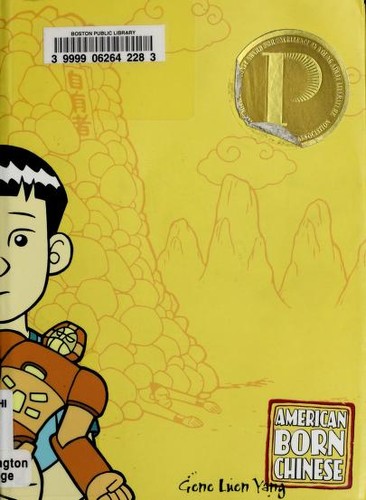
American Born Chinese
Gene Luen Yang (2006)
“Three stories about hiding who you are — a Chinese folk hero, a second-generation kid, and a sitcom nightmare — crash together in a twist that redefines all of them.”
American Born Chinese— Summary & Analysis
by Gene Luen Yang · published 2006 · 233 pages · Contemporary / 21st Century
A user-friendly study guide for American Born Chinese by Gene Luen Yang (2006): a high-level plot summary, full chapter-by-chapter analysis, theme breakdowns, character profiles, and 30 essay questions designed for middle-school, high-school, ap-english readers. Unlike a stock summary, sumsumsum.com adds a diction analysis drawn from Gene Luen Yang’s actual text, the 2 documented AP Literature exam appearances of this book, and reading-difficulty guidance (Easy, 2/10) so students, teachers, and lifelong readers know what they are walking into.
“Three stories about hiding who you are — a Chinese folk hero, a second-generation kid, and a sitcom nightmare — crash together in a twist that redefines all of them.”
Short Summary
Three seemingly separate stories interweave: the Monkey King, a deity who refuses to accept he is a monkey; Jin Wang, a Chinese American boy navigating white suburban middle school; and Danny, an all-American teen humiliated by annual visits from his grotesque Chinese cousin Chin-Kee. In a stunning convergence, the three strands reveal themselves as one story about shame, identity, and the cost of trying to be someone you are not. The Monkey King is Wei-Chen's father, Chin-Kee is the Monkey King in disguise, and Danny is actually Jin — who transformed himself to escape his Chineseness. Acceptance of self, the novel argues through both myth and realism, is the only path to wholeness.
Detailed Summary
Gene Luen Yang's American Born Chinese braids three narrative strands that appear unrelated until a climactic twist fuses them into a single meditation on racial identity, self-hatred, and transformation. The first strand retells the Chinese legend of the Monkey King, ruler of Flower-Fruit Mountain...
Summary in the Author’s Writing Style
A retelling of American Born Chinese in Gene Luen Yang’s style — so you can hear the language, not just the plot. This is a stylistic pastiche written by sumsumsum, not an excerpt from the book.
PANEL ONE. The Monkey King rules Flower-Fruit Mountain, and on this mountain he is the finest of all monkeys, master of the four major heavenly disciplines, master of the twelve minor. PANEL TWO. He climbs to a dinner party in the clouds. PANEL THREE. The guard at the gate looks down at his bare fee…
Chapter-by-Chapter Analysis
If you liked American Born Chinese, read next
Start with Maus by Art Spiegelman — The landmark graphic novel about racial identity — Spiegelman uses animal metaphors for ethnic groups, Yang uses caricature; both make racism visible through the medium itself. Then try Persepolis by Marjane Satrapi — Another graphic memoir of cultural displacement — Satrapi navigates Iranian-European identity as Yang navigates Chinese-American, both finding the graphic novel form essential to their argument. Or pivot to Invisible Man by Ralph Ellison — The great American novel about racial identity and visibility — Ellison's narrator is unseen because of his race; Jin transforms himself because he is too visible.
For comparative essays, pair American Born Chinese with
The strongest comparative pairing is The Joy Luck Club (Amy Tan) — The foundational Chinese American identity novel — interlocking stories of mothers and daughters negotiating between Chinese heritage and American assimilation.
Each of these pairings opens a clean thesis path on shared themes, period diction, or formal influence — useful for AP Lit / IB / first-year college comparative essays.