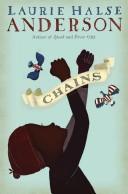
Chains
Laurie Halse Anderson (2008)
“A thirteen-year-old enslaved girl discovers that the Revolutionary War's promise of liberty was never meant for her.”
This page prints on a single page. Use Ctrl+P / Cmd+P.
Chains
Laurie Halse Anderson (2008) · 316pages · Contemporary Young Adult Historical Fiction · 1 AP appearances
Summary
Isabel, a thirteen-year-old enslaved girl in 1776 New York, is promised freedom in her owner's will but is instead sold — along with her younger sister Ruth — to the cruel Loyalist Anne Lockton. As the American Revolution rages around her, Isabel spies for the Patriot rebels in exchange for the promise of emancipation. When both sides betray her and Ruth is sold away, Isabel is branded on the cheek with the letter 'I' for insolence. She ultimately realizes that neither Patriot nor Loyalist will free her, and she must seize her own liberty. On Christmas night 1776, Isabel escapes across the river to New Jersey, taking the imprisoned Patriot soldier Curzon with her.
Why It Matters
Chains is one of the first widely adopted middle-grade novels to place an enslaved protagonist at the center of the American Revolution. Before its publication, the dominant narrative of the Revolution in children's literature focused almost exclusively on white Patriot perspectives. Anderson's n...
Themes & Motifs
Diction & Style
Register: Controlled, period-inflected first person — formal syntax reflecting both the historical setting and Isabel's learned caution as an enslaved narrator
Narrator: Isabel: first-person, retrospective, observational. She watches before she speaks, catalogs before she acts, and repo...
Figurative Language: Moderate
Historical Context
1776 — American Revolution, British occupation of New York City: The American Revolution provides the novel's central irony: a war fought for liberty by a nation that enslaved roughly twenty percent of its population. Anderson uses the historical setting not as ...
Key Characters
Talking Points
- The novel is titled Chains — not Slavery, not Bondage, not Captivity. Why 'chains' specifically? What does the word carry that those alternatives do not, and how does its meaning shift by the novel's end?
- Isabel spies for the Patriots and delivers intelligence that helps foil an assassination plot against George Washington. The Patriots reward her with nothing. Why does Anderson include this betrayal, and what argument is she making about the Revolution's relationship to enslaved people?
- The branding scene is the most physically violent moment in the novel. Why does Anderson write it in such graphic, sensory detail rather than cutting away? What is the reader's responsibility when confronted with this scene?
- Isabel reclaims the 'I' branded on her cheek as standing for 'Isabel' rather than 'insolence.' Is this reclamation convincing, or is it a coping mechanism? Can a mark of oppression truly be transformed into a mark of identity?
- Anderson sets Isabel's escape on the same night as Washington's crossing of the Delaware. Why this parallel? What is Anderson arguing by placing a personal escape alongside a national military operation?
Why Read This
Because the American Revolution you learned about in elementary school left out the people who mattered most. Chains puts you inside the experience of a girl your age who watches the Declaration of Independence being celebrated by people who own h...