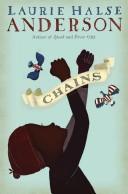
Chains
Laurie Halse Anderson (2008)
“A thirteen-year-old enslaved girl discovers that the Revolutionary War's promise of liberty was never meant for her.”
Language Register
Controlled, period-inflected first person — formal syntax reflecting both the historical setting and Isabel's learned caution as an enslaved narrator
Syntax Profile
Isabel's narration uses short, declarative sentences — the syntax of someone who has learned that economy of language is a survival skill. Observations are physical and concrete rather than abstract. Emotional states are conveyed through sensory detail (what Isabel sees, hears, smells) rather than direct statement. The restraint breaks only at moments of extreme crisis — Ruth's sale, the branding — where the sentences contract to fragments.
Figurative Language
Moderate — Anderson uses metaphor sparingly and deliberately. The dominant figurative pattern is irony rather than imagery: the language of the Declaration set against the reality of enslavement, the word 'freedom' spoken by people who own other people. When metaphors appear, they are drawn from the physical world of labor and confinement — chains, iron, water, fire.
Era-Specific Language
Period term for epileptic seizures — used to describe Ruth's condition, reflecting 18th-century medical understanding
The two political allegiances dividing colonial New York — neither of which includes enslaved people as stakeholders
Written document required for enslaved people to move through public spaces — literacy made forgery possible
Legal punishment marking enslaved people as property — a common practice in colonial America
The charge applied to any enslaved person who spoke, acted, or looked at an owner in a way deemed disrespectful
How Characters Speak — Class & Identity
Isabel
Controlled, observational, precise. Short sentences. Avoids emotional language. Reports rather than interprets.
The diction of an enslaved person who has learned that careless speech is punished. Every word is measured against its potential consequences.
Madam Lockton
Imperious, commanding, prone to eruption. Uses the language of ownership — 'my property,' 'my household' — as natural extensions of her authority.
The linguistic register of a slaveholding woman who considers her authority absolute and divinely sanctioned.
Curzon
Optimistic, rhetorical, borrowing the vocabulary of Patriot political philosophy. Speaks in ideals rather than observations.
An enslaved boy who has absorbed his owner's political language and genuinely believes it will apply to him. The gap between his rhetoric and his reality mirrors the nation's.
Lady Seymour
Measured, genteel, occasionally warm. Speaks to Isabel with a courtesy that acknowledges personhood without questioning the system that denies it.
The kindest voice in the novel is still a voice that accepts slavery as a social fact. Decency within an indecent system.
Narrator's Voice
Isabel: first-person, retrospective, observational. She watches before she speaks, catalogs before she acts, and reports events with a restraint that masks enormous intelligence. The voice is deliberately mature for a thirteen-year-old — Anderson writes Isabel as a child who has been forced into adult cognition by the conditions of her enslavement.
Tone Progression
Chapters 1-10
Cautious, watchful, strategically hopeful
Isabel navigates a new household and a new city, maintaining hope that the system might work for her — through the will, through the Patriots.
Chapters 11-25
Disillusioned, grieving, hardening
Betrayal by the Patriots, Ruth's sale, and the branding strip away every external source of hope. Isabel's voice contracts and hardens.
Chapters 26-46
Resolute, calculating, liberated
Isabel shifts from endurance to agency. The prose opens as she plans and executes her escape. The final chapters achieve a cadence of determined motion.
Stylistic Comparisons
- Frederick Douglass's Narrative — the same controlled fury, the same use of literacy as a weapon, the same refusal to sentimentalize the enslaved experience
- Toni Morrison's Beloved — shares the insistence that slavery's violence must be felt, not summarized, though Morrison's prose is more lyrical and fragmented
- Gary Paulsen's Nightjohn — another YA treatment of literacy as liberation under slavery, though Anderson's novel is broader in historical scope
Key Vocabulary from This Book
Notable words used in this text — click to see full definitions