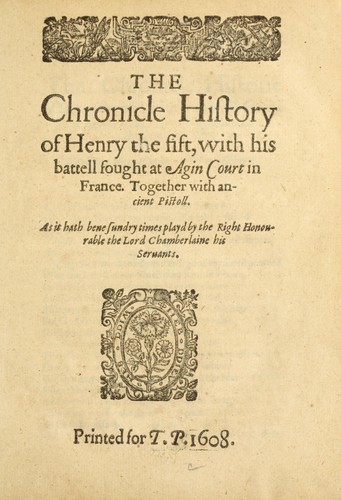
Henry V
William Shakespeare (1599)
“A young king invades France, wins an impossible battle, and delivers the greatest motivational speech in English literature — but Shakespeare keeps asking whether any of it is heroic.”
Language Register
Public oratory dominant — Henry's speeches are designed for audiences within the play, making the entire text a study in rhetoric as performance
Syntax Profile
Henry's public speeches use periodic sentence structure — long subordinate clauses building toward a climactic main clause that delivers the emotional payload. The St Crispin's Day speech builds through conditional clauses ('if we are marked to die'), temporal projections ('then shall our names'), and parallel structures before arriving at 'we band of brothers.' This architectural syntax is designed for oral delivery and group persuasion. The Chorus speaks in rich, descriptive verse that is more literary than Henry's oratory — designed for a single speaker addressing an audience rather than a leader addressing soldiers.
Figurative Language
Moderate to high — concentrated in the set-piece speeches. Animal imagery dominates the battle rhetoric (tiger, greyhound, eagle). The Harfleur threats use domestic imagery turned monstrous (infants, mothers, old men). The wooing scene is almost bare of figurative language — Henry's 'plain soldier' persona strips metaphor away. The Chorus uses the most elaborate metaphors in the play, consistently comparing the theater to the world and asking the audience to perform the imaginative work the stage cannot.
Era-Specific Language
Resident ambassador — diplomatic vocabulary reflecting the play's political negotiations
A call to arms, a battle signal — stage direction term that was also the real military vocabulary of the period
A small metal image of the crucifix, kissed as part of the Mass — Pistol's bawdy misuse of religious objects
Cousin — used broadly for any relative or close associate, not just first cousins
A small Dutch coin of negligible value — used for emphasis in contempt ('not worth a doit')
How Characters Speak — Class & Identity
Henry V
Multiple registers deployed strategically: soaring oratory for public speeches, controlled verse for political scenes, simplified English for the Katherine scene, disguised plainness when walking among soldiers. He speaks differently to every audience.
A king who is always performing, always calibrating his language to his listener. His greatest skill is making each audience feel they are hearing the real Henry. Whether any audience actually is remains the play's central question.
The Chorus
Elaborate, self-conscious verse that constantly draws attention to the gap between theatrical representation and reality. The most 'literary' voice in the play.
Shakespeare speaking directly about the limits and powers of his own medium. The Chorus is the play's conscience — the voice that insists on honesty about the fact that everything you are watching is constructed.
Fluellen
Formal English with Welsh phonetic markers ('look you,' 'prave' for 'brave,' 'Cheshu' for 'Jesu'). Pedantic about classical military discipline.
National identity expressed through linguistic difference. Fluellen's Welsh accent marks him as other within the English army, but his obsession with military rules makes him more English than the English. His loyalty to Henry is absolute and unquestioned — which is both admirable and the condition of a colonized subject.
Pistol
Bombastic, overblown verse that parodies heroic speech. Every line sounds like a bad play — theatrical language emptied of meaning.
The tavern world's version of Henry's rhetoric: all performance, no substance. Pistol talks like a hero and behaves like a coward. He is the dark mirror of a king who talks like a hero and may — or may not — be one.
Katherine
French with increasingly broken English. Her mispronunciations generate comedy but also encode the violence of linguistic assimilation.
A princess learning the language of conquest. Her errors are charming on stage and coercive in context. The language lesson is also a lesson in submission.
Michael Williams
Plain, direct prose. No rhetorical flourishes. Blunt questions that refuse to be deflected.
The common soldier who cuts through royal rhetoric with moral clarity. Williams asks the questions Henry cannot answer. His plainness is more honest than any of Henry's performed plainness.
Narrator's Voice
The Chorus functions as the play's narrator — the only character who addresses the audience directly, provides scene-setting, and comments on the action. Unlike a novel's narrator, the Chorus is openly unreliable: it describes events in grander terms than Shakespeare then dramatizes them. The Chorus says the army is glorious; the scenes show it is starving. The gap between narration and dramatization is the play's most sophisticated structural device.
Tone Progression
Act I
Political, calculating
Legal arguments, political maneuvering, the machinery of war presented in its institutional dimension.
Act II
Elegiac and ruthless simultaneously
Falstaff's death as emotional anchor; the conspirators' execution as political theater. Grief and power coexist.
Act III
Heroic surface, disturbing undertow
The great speeches arrive alongside their complications — the breach speech followed by cowardly soldiers, the Harfleur threats shadowing the Harfleur victory.
Act IV
Philosophically urgent, then triumphant, then morally ambiguous
The Williams debate, the St Crispin's Day speech, the battle, the prisoners. The play's full emotional and moral range in one act.
Act V
Comic, tender, and quietly devastating
The wooing scene's charm undercut by the Epilogue's destruction of everything the play has celebrated.
Stylistic Comparisons
- Hamlet — where Hamlet thinks too much to act, Henry acts too effectively to think. Both plays interrogate the relationship between language and power, but from opposite directions
- Julius Caesar — another play about political rhetoric, assassination, and the gap between a leader's public image and private self. Brutus and Henry are both idealists who rationalize violence
- Wilfred Owen's war poetry — Owen's 'Dulce et Decorum Est' is the direct descendant of the tension Shakespeare builds between the St Crispin's Day speech and the killing of the prisoners
Key Vocabulary from This Book
Notable words used in this text — click to see full definitions