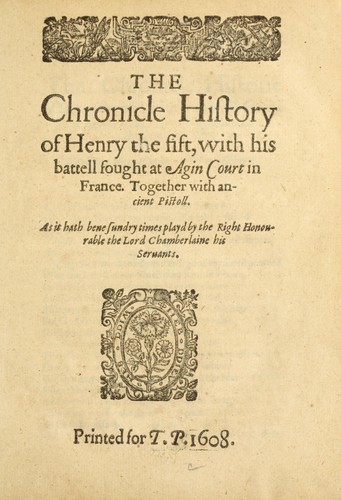
Henry V
William Shakespeare (1599)
“A young king invades France, wins an impossible battle, and delivers the greatest motivational speech in English literature — but Shakespeare keeps asking whether any of it is heroic.”
Henry V— Historical Context & Author Background
Author: William Shakespeare · Published 1599· Era: Renaissance / Elizabethan·90 pages
Themes explored: leadership, war, honor, power, identity, language, nationalism
About William Shakespeare
William Shakespeare (1564-1616) wrote Henry V in 1599, the same year the Globe Theatre opened — making this play a statement about what the new theater could do. Shakespeare was at the peak of his career, having completed the entire second tetralogy (Richard II, Henry IV Parts 1 and 2, Henry V) over roughly four years. England in 1599 was engaged in the Earl of Essex's military campaign in Ireland, which was going badly. The Chorus's reference to 'the General of our gracious Empress' returning from Ireland 'with rebellion broached on his sword' is the play's most topical allusion — and Essex's campaign would fail spectacularly, leading to his rebellion and execution in 1601. Shakespeare wrote a play celebrating military triumph while his nation's actual military campaign was collapsing.
Life → Text Connections
How William Shakespeare's real experiences shaped specific elements of Henry V.
The Globe Theatre opened in 1599 — Henry V was likely among the first plays performed there
The Chorus's constant references to the theater's limitations ('Can this cockpit hold the vasty fields of France?') and appeals to imagination
Shakespeare inaugurated his new theater with a play about what theater cannot do. The Chorus is both an apology for the Globe's limitations and an advertisement for its ambitions. It is a mission statement disguised as modesty.
The Earl of Essex's Irish campaign (1599) — England's real war while Shakespeare was writing about a fictional one
The Chorus explicitly compares Henry's triumphant return to Essex's anticipated return from Ireland
Essex failed in Ireland, was stripped of his offices, and later executed for rebellion. Shakespeare's comparison of Henry to Essex was either sincere patriotic hope or dramatic irony — and the audience's experience of the line changed entirely depending on when they saw the play.
Shakespeare had already written the Henry VI plays (1590-92), dramatizing the loss of everything Henry V won
The Epilogue tells the audience that Henry VI lost France and caused civil war — a story the audience had already seen on Shakespeare's stage
Shakespeare wrote the end before the beginning. His audience knew Henry V's victories were temporary because they had already watched the sequels. The play is written to be consumed with foreknowledge of failure.
Shakespeare was an actor and theater shareholder — commercially invested in plays that drew audiences
The play's dual nature as patriotic crowd-pleaser and ironic political commentary
Shakespeare needed Henry V to work as entertainment (patriotic speeches, battle scenes, comedy, romance) and as art (moral ambiguity, structural irony, metatheatrical commentary). The play's enduring power comes from its success at both levels simultaneously.
Historical Era
Late Elizabethan England, 1599 — theater boom, Irish wars, succession anxiety
How the Era Shapes the Book
Henry V was written for an audience that needed patriotism (Essex was in Ireland, the Armada was recent memory, Elizabeth was dying without an heir) and could handle complexity (the Globe's audiences were sophisticated enough to register the play's ironic undercurrents). The play delivers both: a patriotic epic that simultaneously questions whether patriotic epics are trustworthy. The Chorus's theatrical self-consciousness is specific to 1599 — the Globe was new, the art form was evolving, and Shakespeare was thinking aloud about what this medium could accomplish.
Why Henry V Matters Historically
Henry V is the most influential work of English-language war literature. The St Crispin's Day speech has been quoted by military leaders from Wellington to Eisenhower. The play established the template for the 'band of brothers' narrative that shapes how English-speaking cultures think about war: a small group of brave men, outnumbered but morally unified, defeating a larger enemy through courage and fellowship. But Shakespeare also embedded the counter-narrative — the killing of prisoners, the coerced marriage, the Chorus's theatrical disclaimers, the Epilogue's destruction of the victory — ensuring that every generation can find both the patriotic reading and the anti-war reading in the same text.
- First major dramatic work to use a Chorus as sustained metatheatrical commentary on the nature of theatrical representation itself
- Created the 'band of brothers' concept that would define English-language military rhetoric for centuries
- First literary work to present a military leader as simultaneously heroic and morally ambiguous without resolving the tension
- The Katherine scene is the earliest extended bilingual dialogue in English drama
- First major war narrative to embed its own critique — the Epilogue is structural anti-war commentary built into a pro-war play
Henry V has not been banned but has been aggressively curated. Olivier's 1944 film cut the killing of the prisoners, the Harfleur atrocity threats, and most of the moral ambiguity — producing a pure propaganda film. Branagh's 1989 film restored the violence but softened the wooing scene. No production has ever successfully staged every element the text contains: the patriotism, the war crimes, the comedy, the coercion, the metatheatrical commentary, and the Epilogue's nihilism. The play resists completeness because its elements contradict each other by design.