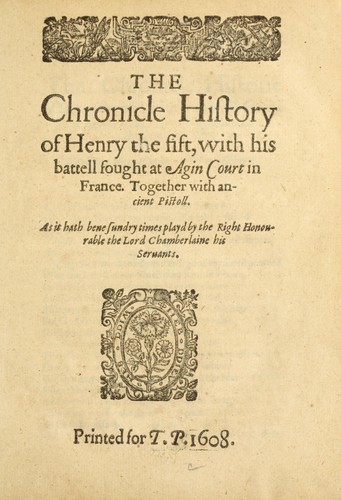
Henry V
William Shakespeare (1599)
“A young king invades France, wins an impossible battle, and delivers the greatest motivational speech in English literature — but Shakespeare keeps asking whether any of it is heroic.”
Why This Book Matters
Henry V is the most influential work of English-language war literature. The St Crispin's Day speech has been quoted by military leaders from Wellington to Eisenhower. The play established the template for the 'band of brothers' narrative that shapes how English-speaking cultures think about war: a small group of brave men, outnumbered but morally unified, defeating a larger enemy through courage and fellowship. But Shakespeare also embedded the counter-narrative — the killing of prisoners, the coerced marriage, the Chorus's theatrical disclaimers, the Epilogue's destruction of the victory — ensuring that every generation can find both the patriotic reading and the anti-war reading in the same text.
Firsts & Innovations
First major dramatic work to use a Chorus as sustained metatheatrical commentary on the nature of theatrical representation itself
Created the 'band of brothers' concept that would define English-language military rhetoric for centuries
First literary work to present a military leader as simultaneously heroic and morally ambiguous without resolving the tension
The Katherine scene is the earliest extended bilingual dialogue in English drama
First major war narrative to embed its own critique — the Epilogue is structural anti-war commentary built into a pro-war play
Cultural Impact
The St Crispin's Day speech has been used as actual military motivation from the Napoleonic Wars through World War II to the present day
Laurence Olivier's 1944 film was funded partly by the British government as wartime propaganda — Winston Churchill recognized the play's patriotic power
Kenneth Branagh's 1989 film reframed the play as post-Vietnam, post-Falklands anti-war cinema — using the same text Olivier used for propaganda
The phrase 'band of brothers' was adopted by Stephen Ambrose for his World War II history and subsequently by HBO for the acclaimed miniseries
'Once more unto the breach' is one of the most quoted phrases in the English language, used in contexts from business to sports
The play's dual nature — patriotic and ironic — makes it the default text for any culture trying to process the relationship between military glory and military horror
Banned & Challenged
Henry V has not been banned but has been aggressively curated. Olivier's 1944 film cut the killing of the prisoners, the Harfleur atrocity threats, and most of the moral ambiguity — producing a pure propaganda film. Branagh's 1989 film restored the violence but softened the wooing scene. No production has ever successfully staged every element the text contains: the patriotism, the war crimes, the comedy, the coercion, the metatheatrical commentary, and the Epilogue's nihilism. The play resists completeness because its elements contradict each other by design.