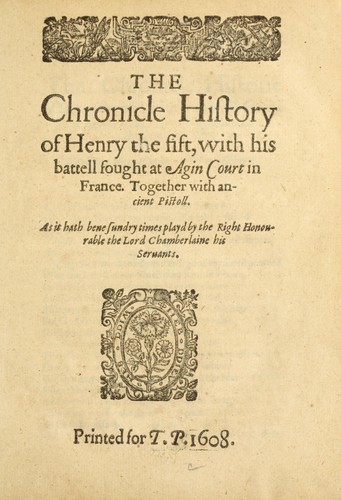
Henry V
William Shakespeare (1599)
“A young king invades France, wins an impossible battle, and delivers the greatest motivational speech in English literature — but Shakespeare keeps asking whether any of it is heroic.”
Essay Questions & Food for Thought
30questions designed to challenge assumptions and provoke original thinking. These can't be answered from a summary — you need the actual text.
The Archbishop of Canterbury provides the legal justification for war in Act I — but only after we learn the church has financial reasons to support the invasion. Does this undermine Henry's claim to moral legitimacy? Can a war be just even if its supporters have ulterior motives?
Compare Henry's 'Once more unto the breach' speech with his threat to the citizens of Harfleur. Both use the same rhetorical skill. What does this versatility tell us about the relationship between eloquence and morality?
The Chorus constantly reminds the audience that they are watching a play, not a real war. Why does Shakespeare include this device? Does it enhance or undermine Henry's heroism?
Falstaff dies offstage and the Boy says 'the King has killed his heart.' How does Falstaff's absence haunt the play? Would Henry V be a different play if Falstaff appeared in it?
Michael Williams argues that if the king's cause is unjust, the king is responsible for every death. Henry responds that each soldier's soul is his own business. Who wins this argument? Can both be right?
Henry orders the killing of the French prisoners at Agincourt. Is this a war crime, a tactical necessity, or justified retaliation for the French attack on the baggage train? Does the play give you enough information to decide?
The St Crispin's Day speech promises that commoners who fight will be made equal to nobles: 'be he ne'er so vile, this day shall gentle his condition.' Does the play deliver on this promise? What happens to the common soldiers after the battle?
Katherine's English lesson scene is played for comedy, but she is learning the language of her conqueror. How does the scene change if you read it as preparation for a forced marriage rather than a charming language game?
Compare Laurence Olivier's 1944 film of Henry V (made during World War II as patriotic propaganda) with Kenneth Branagh's 1989 film (made after the Falklands War as an anti-war statement). Both use the same text. How can the same play support such opposite interpretations?
Henry disguises himself to walk among his soldiers the night before Agincourt. Why? What does he learn? Does his soliloquy afterward suggest the experience changed him or confirmed what he already believed?
Macmorris asks 'What ish my nation?' in a play about English nationalism and French conquest. Shakespeare wrote this while England was fighting a war in Ireland. What is Shakespeare doing with Irish identity in this play?
Henry says 'I speak to thee plain soldier' to Katherine in the wooing scene. But Henry has just delivered some of the most sophisticated speeches in English literature. Is his plainness genuine or a performance? Can there be a 'real' Henry behind all the performances?
The Epilogue tells us that Henry V's son lost everything his father won. Why does Shakespeare include this? How does knowing the ending changes how you experience the triumph of Agincourt?
Pistol speaks in bombastic pseudo-heroic verse that sounds like a parody of Henry's speeches. Is Pistol a commentary on Henry's rhetoric? What does it mean that the same kind of language can be heroic and ridiculous?
Henry attributes the victory at Agincourt entirely to God and forbids any man to claim personal credit. Is this genuine piety or a political move to prevent any noble from gaining too much prestige? Can it be both?
The play presents four captains — Welsh, Irish, Scottish, and English — fighting together. Is this a celebration of British unity or an exposure of the tensions within it? How do the captains' interactions reveal national hierarchies?
Henry's soliloquy on kingship ('Upon the King!') reveals a man who envies the peasant's ability to sleep without worry. Is this self-awareness or self-pity? How does this speech compare to the public confidence of the St Crispin's Day speech that follows it?
The 'Once more unto the breach' speech asks soldiers to 'imitate the action of the tiger' — to become animals. What does it mean that Henry's most inspirational speech explicitly asks men to suppress their humanity?
Bardolph, Nym, and Pistol follow the breach speech with cowardice and thieving. Bardolph is later hanged for stealing from a church. Why does Shakespeare place the low comic characters directly after the heroic speeches?
Henry tells the Governor of Harfleur that his soldiers will rape women and kill infants if the city does not surrender. The city surrenders, and Henry shows mercy. Was the threat a bluff? Does it matter whether he would have carried it out?
Compare Henry V to a modern political leader who uses inspiring rhetoric to justify military action. What parallels do you see between Henry's methods and contemporary political communication?
The play was written in 1599 and set in 1415. How does Shakespeare use the historical distance to comment on his own era? What parallels between Henry's France campaign and Elizabeth's Ireland campaign would the original audience have noticed?
Is Henry V a patriotic play or an anti-war play? Make the strongest case for each reading using specific textual evidence.
Henry traps the Cambridge conspirators into arguing against mercy, then applies their own standard to condemn them. Is this justice or manipulation? Compare this scene to a modern legal or political trap.
Mistress Quickly's description of Falstaff's death ('a babbled of green fields') is one of Shakespeare's most moving passages, delivered in plain prose by an uneducated woman. Why does Shakespeare give the play's most emotionally powerful language to its least educated character?
The wooing scene between Henry and Katherine takes place after a war. Katherine's hand is a term of the peace treaty. Can there be genuine romance in a relationship founded on conquest? Does the play present their courtship as love or as politics?
Fluellen compares Henry to Alexander the Great and almost says Alexander killed his best friend Cleitus while drunk — before catching himself and changing the subject. Henry killed Falstaff metaphorically by rejecting him. Is Fluellen's comparison more apt than he realizes?
The Chorus says 'Can this cockpit hold the vasty fields of France?' and asks the audience to 'piece out our imperfections with your thoughts.' Why does Shakespeare draw attention to his own play's limitations? How does this affect your experience as a reader or viewer?
Henry says 'We few, we happy few, we band of brothers.' The word 'happy' is doing unusual work in this line. Why are few soldiers 'happy' rather than terrifying? What does 'happy' mean in this context?
If you were directing Henry V today, would you make it a patriotic celebration or an anti-war critique? What scenes would you emphasize, what would you cut, and what would your Agincourt look like? Defend your choices with the text.