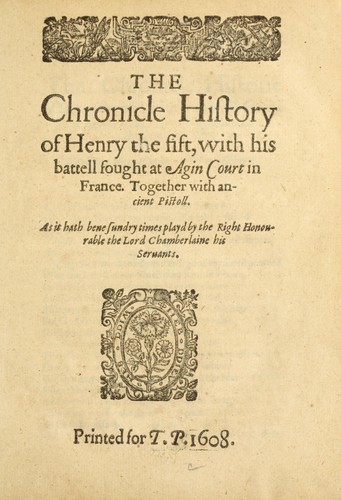
Henry V
William Shakespeare (1599)
“A young king invades France, wins an impossible battle, and delivers the greatest motivational speech in English literature — but Shakespeare keeps asking whether any of it is heroic.”
For Students
Because Henry V is the original debate about whether war can be heroic. The St Crispin's Day speech will make you want to follow Henry into battle. The killing of the prisoners will make you wonder if you should. The Harfleur threats will disturb you. The Katherine scene will charm you and then make you uncomfortable when you think about it. And the Epilogue will tell you that everything the play celebrated was undone within a generation. Shakespeare does not tell you what to think about any of this. He gives you all the evidence and leaves you to argue — with the text, with your classmates, with yourself. That is what great literature does.
For Teachers
Henry V is the ideal text for teaching rhetoric as a morally neutral tool. The same king who delivers the St Crispin's Day speech also threatens Harfleur with infanticide — same rhetorical gift, different purpose. The Chorus provides a built-in lesson on metatheatrical framing and the unreliable narrator. The Branagh/Olivier comparison is a ready-made unit on how film adaptation shapes interpretation. The Williams debate is the most accessible philosophical dialogue in Shakespeare — students immediately recognize the moral problem. And the play's refusal to resolve its central ambiguity (hero or war criminal?) teaches students to sit with complexity rather than reach for easy answers.
Why It Still Matters
Every nation tells itself stories about its wars. Henry V is the play that shows you how those stories are built — the rhetoric that makes sacrifice feel glorious, the reality that makes it feel horrific, and the theatrical machinery that presents both simultaneously. In an age of political rhetoric, military intervention, and media-constructed narratives about conflict, the play's central question has never been more relevant: when a brilliant speaker tells you that dying for a cause is noble, how do you know if the cause is just, the speaker is sincere, and the death is worth it?