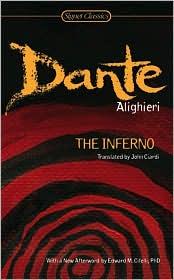
Inferno
Dante Alighieri (1320)
“A poet walks through Hell and finds everyone he ever hated there — then writes the most beautiful poetry in any language to describe their suffering.”
Inferno— Historical Context & Author Background
Author: Dante Alighieri · Published 1320· Era: Medieval/Renaissance·320 pages
Themes explored: justice, morality, religion, power, love-obsession, fate, redemption
About Dante Alighieri
Dante Alighieri (1265-1321) was born in Florence to a family of minor nobility. He was a poet, philosopher, political theorist, and active participant in Florentine civic life. In 1302, his faction (the White Guelphs) lost power, and Dante was exiled from Florence on charges of corruption — charges he always maintained were fabricated. He never returned. The Divine Comedy was written entirely in exile, and the poem's rage against Florentine politics, papal corruption, and the injustice of his banishment burns through every canto. Dante died in Ravenna in 1321, and Florence has been trying to get his bones back ever since.
Life → Text Connections
How Dante Alighieri's real experiences shaped specific elements of Inferno.
Exile from Florence in 1302 — the defining catastrophe of Dante's life
The Inferno is populated with Dante's Florentine enemies, placed in specific circles with specific punishments. The poem is the ultimate act of political revenge: eternal damnation in terza rima.
Understanding that Dante knew many of the people he places in Hell — that they were real political figures, real rivals, real betrayers — transforms the poem from abstract theology into savage personal journalism.
Beatrice Portinari — the woman Dante loved from childhood, who died in 1290 at age twenty-four
Beatrice initiates the entire journey by sending Virgil to rescue Dante. She represents divine love and grace — the force that begins and completes salvation.
The Comedy is, at its deepest level, a love poem. Dante's journey through Hell, Purgatory, and Paradise is driven by his love for a woman who has been dead for ten years. The theological apparatus serves the love story, not the other way around.
Dante's devotion to Virgil and classical learning
Virgil is Dante's guide through Hell and Purgatory — but Virgil is also damned, living in Limbo because he was born before Christ
The central emotional tension of the Inferno: Dante loves Virgil more than any other writer, calls him 'my master and my author,' and yet Virgil is excluded from salvation. The poem is a sustained elegy for pagan genius.
The Guelph-Ghibelline factional wars that defined Florentine politics
Characters from both factions appear throughout Hell, and Dante's political commentary is specific, named, and unforgiving
The Inferno is not merely a theological poem — it is a political weapon. Dante uses the architecture of Hell to settle scores, vindicate his faction, and condemn the corruption he saw in both Church and State.
Historical Era
Late Medieval Italy (1265-1321) — the age of Guelph-Ghibelline conflict, papal power, and the emergence of Italian city-states
How the Era Shapes the Book
The Inferno is inseparable from the factional violence, papal corruption, and intellectual ferment of late medieval Italy. Dante's Hell is populated by real people from his world — popes, politicians, soldiers, scholars — and his moral judgments are shaped by the specific political and theological conflicts of his time. The poem's insistence on the primacy of divine justice over earthly power is a direct response to the Church's abuse of spiritual authority for political gain. The Inferno is medieval in its theology but modern in its rage.
Why Inferno Matters Historically
The Inferno is the foundational text of Italian literature and one of the three or four most influential poems in Western civilization. It essentially created the Italian literary language, elevated the vernacular over Latin as the medium of serious art, and provided the Western imagination with its dominant visual vocabulary for Hell, damnation, and divine justice. Every subsequent depiction of the afterlife — from Milton's Paradise Lost to modern horror films — operates in Dante's shadow.
- The first major literary work in a European vernacular rather than Latin — a revolutionary assertion that common languages could carry epic weight
- The invention of terza rima — the interlocking rhyme scheme that no subsequent poet has matched in sustained use
- The first comprehensive literary mapping of the afterlife as a coherent moral system with internal logic
- The first major Western poem in which the author appears as a character within his own fiction
- The first systematic application of contrapasso — punishment as logical consequence of sin rather than arbitrary torture
The Inferno has never been formally banned by the Catholic Church, despite its explicit condemnation of multiple popes by name. Its status as a supreme achievement of Italian literature and Catholic intellectual tradition has protected it. However, individual episodes have been censored in educational editions — the Muhammad passage in Canto 28 is increasingly omitted or contextualized in modern anthologies, and the graphic violence of the lower circles has been softened in many classroom adaptations.