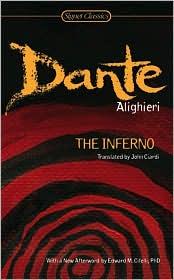
Inferno
Dante Alighieri (1320)
“A poet walks through Hell and finds everyone he ever hated there — then writes the most beautiful poetry in any language to describe their suffering.”
Essay Questions & Food for Thought
30questions designed to challenge assumptions and provoke original thinking. These can't be answered from a summary — you need the actual text.
The Inferno opens with Dante 'midway through the journey of our life' — not 'my life' but 'our life.' Why does Dante make his personal crisis universal from the very first line, and what does this claim about the poem's purpose?
Virgil is Dante's guide through Hell — but Virgil is himself one of the damned, living in Limbo because he was born before Christ. How does this fact affect their relationship and the poem's emotional structure?
Contrapasso means the punishment fits the sin — but more precisely, the punishment IS the sin, experienced eternally. Choose one contrapasso from the Inferno and explain exactly how the punishment reflects the sin's nature, not just its severity.
Francesca da Rimini tells her story beautifully and Dante faints from pity. But is the reader supposed to pity her, or is the scene constructed as a trap? What does your answer reveal about how the Inferno teaches moral reasoning?
Dante places many of his personal political enemies in Hell by name. Is this justified as divine poetry, or is it simply revenge? Can a poem be both a work of transcendent art and an act of personal score-settling?
Why does Dante choose Virgil — a pagan Roman poet — rather than a Christian saint as his guide through Hell? What does this choice say about the relationship between classical learning and Christian faith in the poem?
The vestibule of Hell contains the uncommitted — those who never chose good or evil. Dante despises them more than actual sinners. Why is refusing to choose considered worse than choosing wrong?
Ulysses' speech — 'You were not made to live as brutes, but to follow virtue and knowledge' — is one of the most magnificent lines in the Inferno. But Ulysses is in Hell. How can a speech be both inspiring and damnable? What does this tell us about the relationship between eloquence and truth?
Dante writes in Italian (the vernacular) rather than Latin (the language of learning). This was revolutionary. Why does the choice of language matter, and what does it claim about who is allowed to read — and understand — a poem about divine justice?
In Dante's Hell, fraud is punished more severely than violence. Why? What is it about deception that Dante considers worse than physical harm?
Dante the character faints when he hears Francesca's story and is fascinated by the spectacle of the falsifiers. Virgil rebukes him both times. What is Dante learning as he descends through Hell — and how is the reader supposed to learn alongside him?
Satan at the bottom of Hell is frozen, weeping, and mute — not the charismatic rebel of Milton or the cunning tempter of popular culture. Why does Dante make evil so pathetic? What is the theological argument in making the Devil boring?
Brunetto Latini was Dante's beloved teacher, and Dante treats him with deep respect in Hell. Yet Brunetto is among the sodomites, and Dante placed him there. How do you reconcile personal love with moral judgment — and does the poem reconcile them, or leave the tension unresolved?
The Inferno is an allegory — it operates on multiple levels of meaning simultaneously. Identify one moment that works on both the literal level (this is what happens in Hell) and the allegorical level (this is what it means for the living reader).
Dante invented terza rima — interlocking tercets (ABA BCB CDC) — for the Comedy. What does this rhyme scheme do to the reading experience, and why is it appropriate for a poem about descent?
Count Ugolino's final line — 'Then hunger proved more powerful than grief' — has been debated for seven centuries. Did he eat his children, or did he simply die of starvation? Why does Dante leave the answer ambiguous?
The Inferno ends with the line 'And so we came out, to see the stars again.' Each canticle of the Comedy ends with the word 'stars.' What is the structural and thematic significance of ending a journey through absolute darkness with an image of light?
Dante places Pope Boniface VIII, Pope Nicholas III, and Pope Clement V in Hell — condemning three sitting or recent popes by name. What does this say about Dante's view of the relationship between spiritual authority and moral accountability?
The Inferno contains moments of comedy — the fart-trumpet demon in Malebolge, the squabbling Malebranche, the petty arguments in the falsifiers' ditch. Why does Dante include humor in a poem about eternal damnation?
Pier delle Vigne, the suicide-chancellor, speaks in elaborate rhetorical language even as a tree in Hell. His eloquence is both his greatest quality and his curse. How does Dante use a character's speech style as a form of contrapasso?
Dante calls Virgil 'my master and my author' — the highest praise one writer can give another. How does the Inferno function as a literary conversation between Dante and the classical tradition, and what does Dante's poem claim about surpassing its predecessors?
The Inferno's language becomes progressively cruder as the descent deepens — from the lyrical beauty of the Francesca episode to the scatological vulgarity of Malebolge. Why does Dante degrade his own poetry as the sins degrade?
Treachery — not murder, not fraud, not heresy — is the worst sin in Dante's Hell. Why? What is it about betraying trust that Dante considers worse than any other form of evil?
Dante sets the Inferno during Holy Week of 1300, the Jubilee year declared by Pope Boniface VIII. Why does Dante choose this specific historical moment — a year of supposed spiritual renewal — as the setting for a journey through damnation?
Beatrice never appears in the Inferno — she exists only by report, as the one who sent Virgil to save Dante. Yet she is the poem's ultimate cause. How can an absent character be more powerful than any character who is present?
Many of the damned souls in Hell eagerly tell their stories to Dante, wanting to be remembered in the living world. Why would eternal fame matter to someone who is eternally damned? What does this desire reveal about human nature?
T.S. Eliot wrote that Dante and Shakespeare 'divide the modern world between them.' What is it about the Inferno specifically that gives it this kind of lasting power? What does the poem do that no other poem does?
The Gate of Hell reads: 'I was made by divine power, supreme wisdom, and primal love.' Hell was made by love. How can eternal punishment be an act of love — and does Dante's poem convince you that it can?
Dante writes himself as a character in his own poem — fainting, weeping, arguing with the damned. How does the presence of the author as a character change the reader's relationship to the text? Would the poem work if told by an impersonal narrator?
You have just read a 700-year-old poem about Hell. What image, character, or idea from the Inferno will stay with you — and what does your answer reveal about what the poem understands about you?