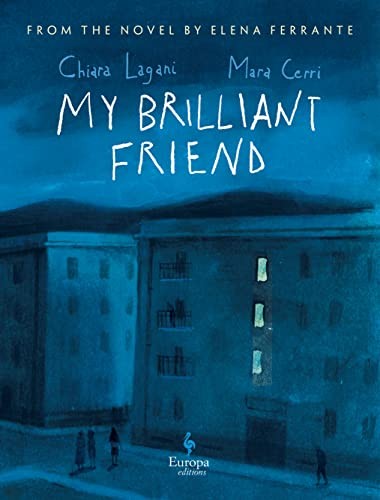
My Brilliant Friend
Elena Ferrante (2011)
“A friendship between two girls in 1950s Naples that is simultaneously a love story, a war story, and a class analysis — told by the one who got out.”
This page prints on a single page. Use Ctrl+P / Cmd+P.
My Brilliant Friend
Elena Ferrante (2011) · 331pages · Contemporary Italian / Neapolitan · 2 AP appearances
Summary
In a poor, violent neighborhood of 1950s Naples, Elena Greco and Raffaella Cerullo — Lenu and Lila — form a fierce, competitive friendship. Lila is the brilliant one: self-taught, fearless, inventive. Elena is the diligent one: obedient, studious, quietly desperate to escape. When Lila is denied education by her father and forced into the family shoe shop, Elena continues through school — always measuring herself against the friend who could have surpassed her. Lila channels her intelligence into designing shoes that become the family's obsession, while the neighborhood's feuds, Camorra violence, and sexual politics close in on both girls. The novel ends with Lila's marriage at sixteen to Stefano Carracci — the son of the fearsome Don Achille — in a wedding that collapses when the Solara brothers arrive wearing the shoes Lila designed, shoes Stefano secretly sold to her enemies.
Why It Matters
The Neapolitan Quartet became a global literary phenomenon — 'Ferrante fever' — that reshaped how female friendship was represented in serious fiction. Before Ferrante, the dominant literary model for intense same-sex bonds was male (Hemingway, Roth, Knausgaard). Ferrante proved that a friendship...
Themes & Motifs
Diction & Style
Register: Deliberately plain and direct in Ann Goldstein's translation — simple syntax, limited ornamentation, an almost reportorial flatness that makes violence and beauty hit with equal force
Narrator: Elena Greco: retrospective, self-aware, unreliable in the way all jealous lovers are unreliable. She tells us repeate...
Figurative Language: Low
Historical Context
1950s-1960s Naples — Post-WWII reconstruction, Italian economic miracle, Southern poverty: Post-war Naples is a city where the state barely functions and the neighborhood fills the vacuum. Don Achille's power comes from wartime black marketeering — he acquired goods, tools, and debts whe...
Key Characters
Talking Points
- The title 'My Brilliant Friend' — who is the brilliant friend? Elena calls Lila brilliant, but Lila might say the same about Elena. Does the novel ever resolve this ambiguity, or is the ambiguity the point?
- Elena's narration begins with 'We'll see who wins this time.' How does framing a sixty-year friendship as a competition shape everything that follows? Is Elena a reliable narrator of her own friendship?
- Lila is denied education because she is a girl from a poor family. Elena is permitted education for the same reasons — she is a girl from a slightly less poor family with a more persuadable father. How does this small difference produce two entirely different lives?
- Ferrante describes violence — fathers beating children, husbands beating wives, neighbors fighting — in flat, unadorned prose. Why does she refuse to dramatize or moralize about the violence? What effect does the flatness create?
- Lila's shoes are a creative masterpiece trapped inside a commercial transaction. How do the shoes function as a metaphor for women's intellectual labor throughout the novel?
Notable Quotes
“We'll see who wins this time.”
“She was the brilliant friend who lent luster to my life.”
“She had a sort of fierce desire to know that I hadn't encountered in anyone.”
Why Read This
Because no other novel captures the experience of measuring yourself against a friend this precisely. The jealousy, the admiration, the guilt, the competition that makes you better and worse simultaneously — Ferrante names what most people feel bu...