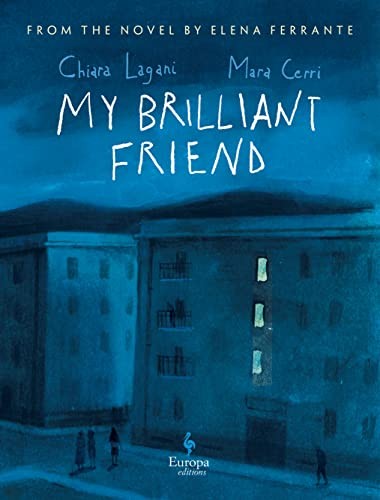
My Brilliant Friend
Elena Ferrante (2011)
“A friendship between two girls in 1950s Naples that is simultaneously a love story, a war story, and a class analysis — told by the one who got out.”
My Brilliant Friend— Historical Context & Author Background
Author: Elena Ferrante · Published 2011· Era: Contemporary Italian / Neapolitan·331 pages
Themes explored: female-friendship, class, education-as-escape, violence, naples, identity, competition, boundaries
About Elena Ferrante
Elena Ferrante is a pseudonym. The author's true identity has never been confirmed, despite investigative journalism pointing to translator Anita Raja. Ferrante has published through Edizioni e/o since 1992, communicating only through letters and refusing all public appearances. The Neapolitan Quartet (2011-2014) brought global fame — translated into 40+ languages, adapted into an HBO series. Ferrante's anonymity is not incidental but central to her project: by removing the author's biography, she forces the reader to encounter the text without the mediating lens of personality, celebrity, or identity. The novels are set in Naples and draw on deep knowledge of its neighborhoods, dialect, and social structures, suggesting biographical connection even as the author denies biographical reading.
Life → Text Connections
How Elena Ferrante's real experiences shaped specific elements of My Brilliant Friend.
Ferrante writes under a pseudonym and refuses all public identification
The novel is narrated by 'Elena' — a name that mirrors the author's chosen pseudonym — writing about a friend who has tried to erase herself entirely
Authorial anonymity and Lila's self-erasure are parallel projects. Both are attempts to exist as intelligence without identity. Ferrante the author is doing what Lila the character wants to do.
The novels demonstrate intimate knowledge of Naples' working-class neighborhoods, dialect, and social hierarchies
The rione is rendered with ethnographic precision — every family, every feud, every economic relationship mapped in detail that suggests lived experience
Whether autobiographical or deeply researched, the specificity of the rione is what makes the novel's class analysis concrete rather than theoretical. The reader trusts it because it feels lived.
Ferrante has written about the relationship between women's intellectual labor and invisibility in essays and interviews
The novel's central tension — Lila's brilliance denied institutional recognition while Elena's diligence is rewarded — enacts Ferrante's feminist argument about whose intelligence 'counts'
Ferrante's anonymity is itself an argument about gender: a woman's work should not require her body, her face, or her biography to be taken seriously.
Ferrante published her first novel, Troubling Love, in 1992, also set in Naples with themes of mother-daughter violence and female identity
The rione's mothers — Elena's limping, raging mother, Lila's exhausted mother — are drawn from the same well of Neapolitan female suffering and resilience
The Neapolitan Quartet extends and deepens concerns Ferrante had been working through for twenty years. The mothers in My Brilliant Friend are not background — they are the future the girls are fighting to escape.
Historical Era
1950s-1960s Naples — Post-WWII reconstruction, Italian economic miracle, Southern poverty
How the Era Shapes the Book
Post-war Naples is a city where the state barely functions and the neighborhood fills the vacuum. Don Achille's power comes from wartime black marketeering — he acquired goods, tools, and debts when the legitimate economy collapsed. The Solaras' power comes from the Camorra, which provides the services (protection, credit, dispute resolution) that the Italian state does not. Education is theoretically available but practically restricted by class, gender, and family economics. The 'economic miracle' happening in Northern Italy is visible on television but absent from the rione. The girls grow up in a place that history is leaving behind, and their choices — education for Elena, marriage for Lila — are shaped by an economy that offers women almost nothing.
Why My Brilliant Friend Matters Historically
The Neapolitan Quartet became a global literary phenomenon — 'Ferrante fever' — that reshaped how female friendship was represented in serious fiction. Before Ferrante, the dominant literary model for intense same-sex bonds was male (Hemingway, Roth, Knausgaard). Ferrante proved that a friendship between two girls in a poor neighborhood could sustain 1,600 pages of literary fiction and sell 15 million copies worldwide. The anonymity added mystique but the books' power is structural: they gave readers a vocabulary for the competitive, jealous, transformative intensity of female friendship that had existed in life but rarely in literature.
- Made female friendship the structural center of a multi-volume literary epic — not a subplot, not a backdrop, but the engine
- Popularized the concept of 'smarginatura' (dissolving margins) as a literary and philosophical idea
- Demonstrated that pseudonymous authorship could amplify rather than diminish a work's cultural impact in the age of author branding
Not widely banned, but challenged in some school settings for sexual content (later volumes), domestic violence, and frank depictions of adolescent sexuality. The novel's treatment of violence against women — presented without redemption or moral framing — has been both praised as feminist realism and criticized as potentially traumatizing for younger readers.