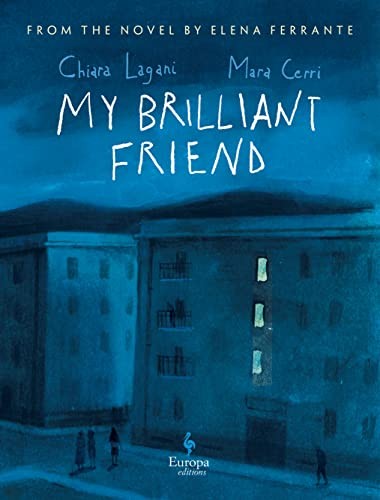
My Brilliant Friend
Elena Ferrante (2011)
“A friendship between two girls in 1950s Naples that is simultaneously a love story, a war story, and a class analysis — told by the one who got out.”
My Brilliant Friend— Summary & Analysis
by Elena Ferrante · published 2011 · 331 pages · Contemporary Italian / Neapolitan
A user-friendly study guide for My Brilliant Friend by Elena Ferrante (2011): a high-level plot summary, full chapter-by-chapter analysis, theme breakdowns, character profiles, and 30 essay questions designed for high-school, ap-english, college readers. Unlike a stock summary, sumsumsum.com adds a diction analysis drawn from Elena Ferrante’s actual text, the 2 documented AP Literature exam appearances of this book, and reading-difficulty guidance (Easy, 3/10) so students, teachers, and lifelong readers know what they are walking into.
“A friendship between two girls in 1950s Naples that is simultaneously a love story, a war story, and a class analysis — told by the one who got out.”
Short Summary
In a poor, violent neighborhood of 1950s Naples, Elena Greco and Raffaella Cerullo — Lenu and Lila — form a fierce, competitive friendship. Lila is the brilliant one: self-taught, fearless, inventive. Elena is the diligent one: obedient, studious, quietly desperate to escape. When Lila is denied education by her father and forced into the family shoe shop, Elena continues through school — always measuring herself against the friend who could have surpassed her. Lila channels her intelligence into designing shoes that become the family's obsession, while the neighborhood's feuds, Camorra violence, and sexual politics close in on both girls. The novel ends with Lila's marriage at sixteen to Stefano Carracci — the son of the fearsome Don Achille — in a wedding that collapses when the Solara brothers arrive wearing the shoes Lila designed, shoes Stefano secretly sold to her enemies.
Detailed Summary
Elena Greco, now in her sixties, begins writing after learning that her oldest friend Lila has vanished — cut herself out of every photograph, erased every trace of her existence. Elena decides to write everything down, starting from childhood in a poor neighborhood (rione) of Naples in the 1950s. ...
Summary in the Author’s Writing Style
A retelling of My Brilliant Friend in Elena Ferrante’s style — so you can hear the language, not just the plot. This is a stylistic pastiche written by sumsumsum, not an excerpt from the book.
This morning Rino called to tell me his mother had vanished. Not died, not run off — vanished. She had cut herself out of every photograph, scraped her name off everything, emptied her room until nothing of her remained. He was frightened. I was not. I knew what she wanted. So I sat down and began t…
Chapter-by-Chapter Analysis
If you liked My Brilliant Friend, read next
Start with The Great Gatsby by F. Scott Fitzgerald — Another novel about brilliance seen through the eyes of a less brilliant narrator — Nick's fascination with Gatsby mirrors Elena's with Lila, and both novels dissect class aspiration through a single friendship. Then try Great Expectations by Charles Dickens — The same story of education as class escape — Pip leaving the forge, Elena leaving the rione — and the same discovery that escape comes with guilt, alienation, and the impossibility of going back. Or pivot to Never Let Me Go by Kazuo Ishiguro — A retrospective narrator reconstructing a friendship shaped by a system that was always going to consume them — the same controlled grief, the same terrible clarity about what was lost.
For comparative essays, pair My Brilliant Friend with
The strongest comparative pairing is The Awakening (Kate Chopin) — Another novel about a woman who sees through the domestic role she is assigned — Edna's dissolution echoes Lila's smarginatura, and both novels end with the system reasserting control.
Each of these pairings opens a clean thesis path on shared themes, period diction, or formal influence — useful for AP Lit / IB / first-year college comparative essays.