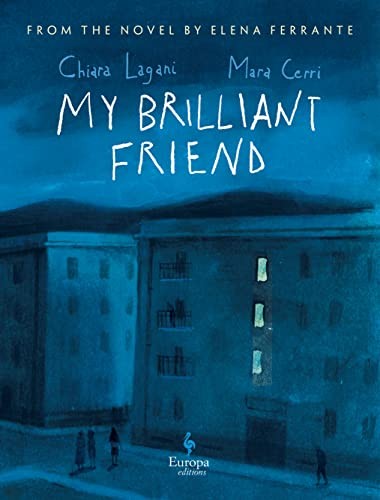
My Brilliant Friend
Elena Ferrante (2011)
“A friendship between two girls in 1950s Naples that is simultaneously a love story, a war story, and a class analysis — told by the one who got out.”
Essay Questions & Food for Thought
30questions designed to challenge assumptions and provoke original thinking. These can't be answered from a summary — you need the actual text.
The title 'My Brilliant Friend' — who is the brilliant friend? Elena calls Lila brilliant, but Lila might say the same about Elena. Does the novel ever resolve this ambiguity, or is the ambiguity the point?
Elena's narration begins with 'We'll see who wins this time.' How does framing a sixty-year friendship as a competition shape everything that follows? Is Elena a reliable narrator of her own friendship?
Lila is denied education because she is a girl from a poor family. Elena is permitted education for the same reasons — she is a girl from a slightly less poor family with a more persuadable father. How does this small difference produce two entirely different lives?
Ferrante describes violence — fathers beating children, husbands beating wives, neighbors fighting — in flat, unadorned prose. Why does she refuse to dramatize or moralize about the violence? What effect does the flatness create?
Lila's shoes are a creative masterpiece trapped inside a commercial transaction. How do the shoes function as a metaphor for women's intellectual labor throughout the novel?
What is smarginatura (dissolving margins)? Is it a psychological condition, a philosophical insight, or a form of intelligence that exceeds what the rione can contain? Does Ferrante present it as illness or knowledge?
Elena and Lila's friendship contains love, jealousy, competition, imitation, resentment, and dependence simultaneously. Is it possible to separate these emotions, or does Ferrante argue that they are the same thing?
Ferrante writes under a pseudonym and refuses all public appearances. Lila, at the novel's opening, has erased all traces of herself. Elena writes to defeat that erasure. How do these three acts — anonymity, erasure, and narration — comment on each other?
Compare how the novel treats education and marriage as parallel 'escape routes' from the rione. Does either actually lead to freedom? What evidence does the novel provide?
The Solara brothers wearing Lila's shoes at her wedding is the novel's climactic image. Why is this more devastating than physical violence would have been? What exactly has been stolen?
How does the rione function as a character in the novel? What are its rules, its economy, its methods of enforcement? Could this story take place anywhere, or is Naples essential?
Stefano Carracci presents himself as a new kind of man — modern, gentle, generous. The wedding reveals he is his father's son. Is Ferrante arguing that individual men cannot escape their social roles, or that Stefano specifically chose not to?
Elena's mother — limping, angry, exhausted — is a constant presence but rarely a subject of analysis. Why does Ferrante give us this mother without explaining her? What does Elena's silence about her mother reveal?
Ferrante's prose in translation (by Ann Goldstein) is notably plain — short sentences, limited adjectives, almost no figurative language. How does this plainness serve the novel's themes? Would more 'literary' prose weaken the effect?
Compare My Brilliant Friend to The Great Gatsby. Both novels are about someone 'brilliant' seen through the eyes of a less brilliant narrator. Both are about class aspiration. How do the two novels' treatments of class, ambition, and narration differ?
Little Women appears in the novel as the book that inspires Elena and Lila to dream of becoming writers. Why does Ferrante choose this specific book? How does Little Women's vision of female ambition compare to what the rione actually offers?
Nino Sarratore is presented as an intellectual ideal in this first volume. Given what the retrospective narrator already knows about how the full story unfolds, are there signs in this volume that Nino is not what he seems?
How would this novel be different if Lila were the narrator instead of Elena? What would we gain, what would we lose, and why did Ferrante choose the 'less brilliant' friend to tell the story?
The novel catalogs the rione's families with almost anthropological precision. Why does Ferrante spend so much time establishing who is related to whom, who owes what, and who fears whom?
Compare the Don Achille apartment scene (the girls confronting the 'ogre') to a fairy tale. How does Ferrante use fairy-tale structure to tell a realistic story about class and power?
Elena describes education as simultaneously liberating and alienating — it gives her tools to think but separates her from the people she loves. Is education presented as salvation or exile in this novel?
The novel begins and ends with acts of writing — Elena deciding to write their story, and the story itself. How does writing function as power in the novel? Who controls the narrative, and what does that control mean?
How does the novel depict the relationship between beauty and danger for women? Lila's beauty attracts the Solaras; Elena's relative plainness protects her. Is beauty presented as an asset or a liability?
Ferrante is Italian, but her global audience reads her in translation. How does translation itself become a theme in a novel about a girl whose intelligence is expressed in a dialect that the educated world doesn't value?
Compare Lila's situation to women today who are brilliant but denied access to education by poverty, geography, or gender. Has the 'Fernando Cerullo problem' — a father who sees no value in a daughter's education — been solved?
Maestra Oliviero fights for both girls' education but ultimately fails Lila. Is the teacher a heroic figure or a symbol of institutional limitations? What could she have done differently?
The novel's structure — Prologue set in the present, then a long flashback to childhood — means the reader always knows this friendship survives to old age. How does this foreknowledge change how you read the childhood sections?
Compare how violence functions in My Brilliant Friend to how it functions in a novel like The Kite Runner or A Thousand Splendid Suns. How do different cultures' violence against women produce different kinds of stories?
Social media has created a culture of constant comparison — measuring your achievements, appearance, and happiness against someone else's curated feed. How is Elena's relationship to Lila a pre-digital version of this phenomenon?
The novel's Italian title is 'L'amica geniale' — literally 'the brilliant friend' but also 'the genius friend.' Does calling Lila a 'genius' change the novel's meaning compared to calling her 'brilliant'? What is the difference between brilliance and genius in the context of this story?