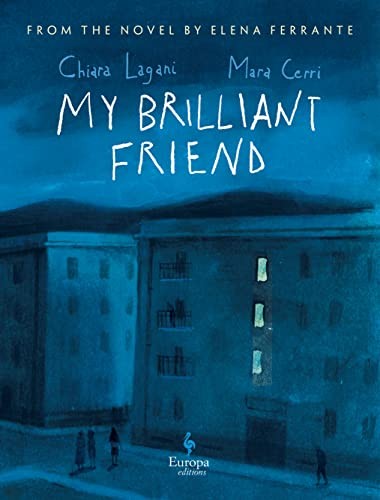
My Brilliant Friend
Elena Ferrante (2011)
“A friendship between two girls in 1950s Naples that is simultaneously a love story, a war story, and a class analysis — told by the one who got out.”
Language Register
Deliberately plain and direct in Ann Goldstein's translation — simple syntax, limited ornamentation, an almost reportorial flatness that makes violence and beauty hit with equal force
Syntax Profile
Short, declarative sentences predominate. Ferrante builds intensity through accumulation rather than complexity — lists of events, catalogs of families, sequences of violence described in the same flat register. Paragraphs can run long, but individual sentences stay short. The effect is of someone speaking quickly, urgently, afraid of losing the listener's attention or her own nerve.
Figurative Language
Low — Ferrante avoids metaphor in favor of direct statement. When figurative language appears (the 'dissolving margins,' the shoes as creative expression), it carries enormous weight precisely because the surrounding prose is so bare. The novel's most devastating insights are delivered without ornamentation.
Era-Specific Language
Neighborhood — a closed social world with its own laws, hierarchies, and codes of honor
Dissolving margins — Lila's term for episodes where reality loses its outlines and things break apart perceptually
Neapolitan organized crime — never named directly but always present in the Solaras' power
The main road of the neighborhood — its boundary with the outside world
Title given to educated women — marks class elevation and neighborhood alienation simultaneously
How Characters Speak — Class & Identity
Elena (narrator)
The retrospective voice uses educated Italian rendered as clean English prose. But when describing childhood, the narrator's language simplifies, as if returning to the rione's register. Elena code-switches across time.
Education changed Elena's language but not her emotional grammar. She thinks in the rione's categories even when she writes in educated prose.
Lila
Direct, sharp, confrontational. She speaks in the dialect of the rione but with a precision that exceeds it. Her language cuts rather than decorates.
Lila's intelligence operates through language the way a blade operates through material — minimum effort, maximum effect. She never needed the educated vocabulary to think clearly.
Stefano Carracci
Polite, measured, modern-sounding — a deliberate departure from his father Don Achille's blunt menace.
New money's second generation learns to perform gentility. Stefano's courtesy is a strategy, not a nature, as the shoe betrayal reveals.
The Solara Brothers
Loud, entitled, sexually aggressive. Their language assumes the right to claim space, attention, and women.
Camorra-adjacent power expressed through casual verbal domination. They don't ask; they announce.
Maestra Oliviero
Formal, institutional, invested with the authority of education as a state project.
The teacher represents the Italian state's claim to civilize the South. Her language carries that mission's condescension and its genuine belief.
Narrator's Voice
Elena Greco: retrospective, self-aware, unreliable in the way all jealous lovers are unreliable. She tells us repeatedly that Lila is the brilliant one, but the telling itself is an act of brilliance — a sixty-year-old woman reconstructing childhood with novelistic precision. The reader must constantly ask: is Lila really as extraordinary as Elena says, or has Elena needed her to be extraordinary in order to explain her own life?
Tone Progression
Prologue
Controlled, determined, competitive
The older Elena frames the story as a response to Lila's disappearance. 'We'll see who wins' — the voice is calm but the stakes are total.
Childhood (Part 1)
Fairy-tale dread, wonder, violence as weather
The rione rendered through children's eyes. Don Achille is an ogre. The dolls are talismans. But the violence is real, and the flatness of the prose refuses to make it magical.
Adolescence (Part 2)
Urgent, competitive, sexually aware, politically awakening
The prose accelerates as the girls' worlds diverge. Elena's sections are studious and anxious. Lila's are electric and dangerous. The wedding finale is controlled devastation.
Stylistic Comparisons
- Karl Ove Knausgaard — similar autobiographical intensity, similar obsession with class shame, but Ferrante is more structurally controlled
- Natalia Ginzburg — Italian literary ancestor, same plainness of style, same attention to family as political unit
- Rachel Cusk — similar formal innovation in narrator positioning, similar refusal of sentimentality
Key Vocabulary from This Book
Notable words used in this text — click to see full definitions