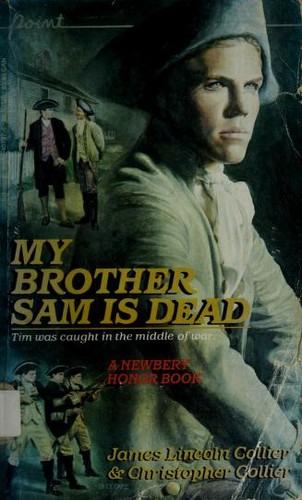
My Brother Sam Is Dead
James Lincoln Collier and Christopher Collier (1974)
“Two brothers. One war. No winners. A shattering story about what the Revolution actually cost the families who lived through it.”
This page prints on a single page. Use Ctrl+P / Cmd+P.
My Brother Sam Is Dead
James Lincoln Collier and Christopher Collier (1974) · 215pages · Contemporary / Historical Fiction
Summary
Told by Tim Meeker, a boy in Tory-leaning Redding, Connecticut, during the American Revolution. His older brother Sam enlists with the Patriots against their father's wishes. Over five years of war, Tim watches his family torn apart: his father dies on a British prison ship, his brother is executed by his own army for a theft he likely didn't commit. Tim survives to old age but can never decide if the war was worth it.
Why It Matters
One of the first young adult novels to present the American Revolution as morally ambiguous rather than heroic. A National Book Award finalist in 1975. Regularly named to lists of the most important works of young adult historical fiction. Taught in nearly every American middle school as a counte...
Themes & Motifs
Diction & Style
Register: Plain and colloquial — a boy's voice rendered honestly, with period-appropriate vocabulary in dialogue
Narrator: Tim Meeker: a boy looking back as an old man on the worst years of his life. The retrospective framing allows the Col...
Figurative Language: Low
Historical Context
American Revolutionary War, 1775-1783 — specifically Loyalist Connecticut: The Colliers chose the Revolution's most uncomfortable truths: that it was a civil war, that Loyalists were not villains, that the Continental Army executed its own soldiers, and that the people wh...
Key Characters
Talking Points
- The novel is told by Tim looking back as an old man. How does this affect the way you read it? What does the framing tell you before the story even starts?
- Sam steals the Brown Bess and calls it fighting for liberty. His father says taking the family's only weapon is putting them in danger. Who is right? Can both be right?
- Life Meeker argues that the Patriots will lose and the British can't be beaten. He turns out to be wrong about the outcome of the war — but is he wrong about the cost? Evaluate his argument.
- The Colliers show violence committed by Patriots and Loyalists alike. Why is it important that no side is shown as purely good or purely evil?
- Tim is left as the man of the household at thirteen. What tasks does he take on, and what does this tell us about how childhood worked differently in colonial times — and in wartime?
Notable Quotes
“Father, you're a Tory. I'm a Patriot. We're on opposite sides.”
“These are just words, Sam. Catch a Hessian soldier with those words.”
“In Redding everybody was afraid of everybody else.”
Why Read This
Because every American learns the story of the Revolution as pure triumph, and this book asks: triumph for whom? Tim Meeker loses his father and his brother and wins a country. The question of whether that trade was worth it is one the country sti...