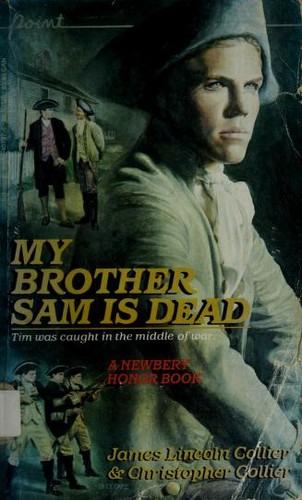
My Brother Sam Is Dead
James Lincoln Collier and Christopher Collier (1974)
“Two brothers. One war. No winners. A shattering story about what the Revolution actually cost the families who lived through it.”
Essay Questions & Food for Thought
30questions designed to challenge assumptions and provoke original thinking. These can't be answered from a summary — you need the actual text.
The novel is told by Tim looking back as an old man. How does this affect the way you read it? What does the framing tell you before the story even starts?
Sam steals the Brown Bess and calls it fighting for liberty. His father says taking the family's only weapon is putting them in danger. Who is right? Can both be right?
Life Meeker argues that the Patriots will lose and the British can't be beaten. He turns out to be wrong about the outcome of the war — but is he wrong about the cost? Evaluate his argument.
The Colliers show violence committed by Patriots and Loyalists alike. Why is it important that no side is shown as purely good or purely evil?
Tim is left as the man of the household at thirteen. What tasks does he take on, and what does this tell us about how childhood worked differently in colonial times — and in wartime?
Life Meeker dies on a British prison ship. What were prison ships, and how does the historical note in the novel change your understanding of his death?
Sam is convicted of cattle theft he almost certainly didn't commit. General Putnam knows the evidence is weak but executes Sam anyway to make an example. Is Putnam a villain? What makes this harder than a simple yes or no?
The Brown Bess travels through the entire story — stolen by Sam, gone during the cattle raid, present at the arrest. Trace what the musket represents at each moment.
Tim testifies at Sam's court martial and tells the complete truth. The truth doesn't save Sam. What does the novel say about the relationship between truth and justice in wartime?
The novel ends with Tim's question: 'Sometimes I wonder if there would have been a way to do it without all the killing.' Is this a hopeful ending, a despairing ending, or something else?
Compare how Sam and Life Meeker each talk about the war. What do the differences in their language tell you about how education and class shape political beliefs?
Betsy Read is entirely convinced the Patriot cause is right. From inside the novel, is she wrong? How do you evaluate someone's conviction when you can see costs they can't?
The Cowboys who take Life prisoner are Loyalists, not British soldiers. What does it tell you about the Revolution that so much of the violence in this novel is American-on-American?
Mother Meeker loses her husband and her son and keeps running the tavern. The novel gives her very little dialogue. Is her silence a limitation of the book or a deliberate choice? What would you want to know from her?
The Colliers include a detailed historical note explaining what is documented fact and what is fiction. Why is this unusual, and why does it matter?
General Putnam is a real historical figure. Look him up. Does knowing his real history change how you read him in the novel? Is it fair to use real people in fiction?
The cattle are stolen twice in this novel — once by the Cowboys who take Life's cattle on the drive, and once by raiders that Sam tries to stop. What is the Colliers doing by repeating this pattern?
The novel was published in 1974, a year before America's Bicentennial. How does that context shape what the Colliers were trying to say? Is this still a relevant book to read today, or is it a product of a specific political moment?
Compare My Brother Sam Is Dead to Johnny Tremain, which tells a far more heroic version of Revolutionary Boston. Which version of the Revolution feels more honest to you, and why?
Tim cannot decide if the Revolution was worth it at the end of his life. Is that indecision a failure of courage or a form of wisdom? What would you need to believe to answer Tim's question?
The enslaved people who lived in colonial Connecticut appear only in the background of this novel. What does their near-absence tell us about the Revolution's promises of 'liberty' — and about the limits of the Colliers' own perspective?
Sam enlists against his father's direct wishes. Is he brave, reckless, or both? How does the novel want you to feel about his decision, and does that feeling change by the end?
Life Meeker tries to stay neutral in a civil war. Is neutrality possible? What happens to people who try to stay out of conflicts that divide their communities?
Tim watches Sam's execution. The Colliers could have had him look away or arrive too late. Why does it matter that he sees it?
The novel argues against romanticizing war. Can you think of a war in your lifetime or recent history that has been romanticized? What details get left out when we tell heroic stories about wars?
At the court martial, the legal system works correctly — rules are followed, evidence is weighed — and produces an unjust result. What does this tell us about the difference between legal and moral?
If Sam had survived the war, do you think he would still believe the Revolution was right? Write the conversation you imagine he and Tim would have had as old men.
The Colliers dedicated the book to 'all the men who served or died at the battle of Redding Ridge.' Look this up. How does the dedication change how you understand the novel's purpose?
Tim says he wishes 'things could be the way they used to be.' This is a wish the novel refuses to grant. What does it mean to want to go back, and why is that wish almost always impossible in wartime?
Would this novel be different if it were told from Sam's point of view instead of Tim's? What would we gain, and what would we lose?