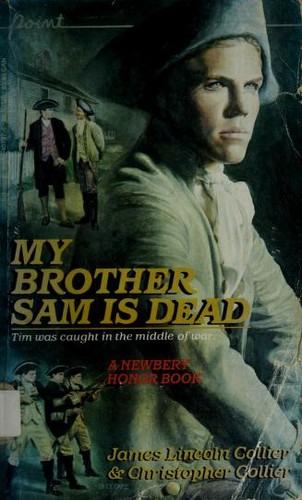
My Brother Sam Is Dead
James Lincoln Collier and Christopher Collier (1974)
“Two brothers. One war. No winners. A shattering story about what the Revolution actually cost the families who lived through it.”
My Brother Sam Is Dead— Summary & Analysis
by James Lincoln Collier and Christopher Collier · published 1974 · 215 pages · Contemporary / Historical Fiction
A user-friendly study guide for My Brother Sam Is Dead by James Lincoln Collier and Christopher Collier (1974): a high-level plot summary, full chapter-by-chapter analysis, theme breakdowns, character profiles, and 30 essay questions designed for middle-school, high-school readers. Unlike a stock summary, sumsumsum.com adds a diction analysis drawn from James Lincoln Collier and Christopher Collier’s actual text, and reading-difficulty guidance (Easy, 1/10) so students, teachers, and lifelong readers know what they are walking into.
“Two brothers. One war. No winners. A shattering story about what the Revolution actually cost the families who lived through it.”
Short Summary
Told by Tim Meeker, a boy in Tory-leaning Redding, Connecticut, during the American Revolution. His older brother Sam enlists with the Patriots against their father's wishes. Over five years of war, Tim watches his family torn apart: his father dies on a British prison ship, his brother is executed by his own army for a theft he likely didn't commit. Tim survives to old age but can never decide if the war was worth it.
Detailed Summary
The story opens in 1775 in Redding, Connecticut — a Tory-sympathizing town where Life Meeker runs a tavern. When Sam comes home from Yale fired up by Patriot politics, he steals the family's only musket (the 'Brown Bess') and runs off to join the Continental Army. His father Eliphalet ('Life') Meeke...
Summary in the Author’s Writing Style
A retelling of My Brother Sam Is Dead in James Lincoln Collier and Christopher Collier’s style — so you can hear the language, not just the plot. This is a stylistic pastiche written by sumsumsum, not an excerpt from the book.
In April of 1775 my brother Sam came home from Yale with the war in his mouth, and nothing in our family was ever the same again. We lived in Redding, in Connecticut, where my father, Eliphalet Meeker, kept the tavern. Most of the men who drank there were Tories, or near enough to it, and they did n…
Chapter-by-Chapter Analysis
If you liked My Brother Sam Is Dead, read next
Start with Johnny Tremain by Esther Forbes — The romantic Patriot version of the Revolution for young readers — same era, opposite emotional and political valence. Then try Across Five Aprils by Irene Hunt — A family torn apart by a different civil war — the structure of brothers on opposite sides, a family managing alone, and a boy becoming a man under wartime grief mirrors the Colliers directly. Or pivot to The Light in the Forest by Conrad Richter — A novel of the same colonial era that similarly refuses the comfortable 'us vs. them' narrative — a boy caught between two cultures with no clean place to belong.
For comparative essays, pair My Brother Sam Is Dead with
The strongest comparative pairing is The Red Badge of Courage (Stephen Crane) — Another novel about a young man's illusions about war destroyed by war's reality — Crane's battlefield interiority compared to the Colliers' domestic damage. Another productive pairing is A Separate Peace (John Knowles) — Brothers (metaphorical here) and war's cost to young men — the pattern of one who dies and one who survives carrying the grief. For a third angle, contrast with Number the Stars (Lois Lowry) — Another historical novel about ordinary families caught between political forces during a war — examines civilian courage and cost with a similar refusal to romanticize.
Each of these pairings opens a clean thesis path on shared themes, period diction, or formal influence — useful for AP Lit / IB / first-year college comparative essays.