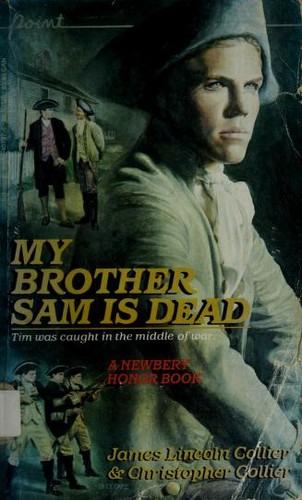
My Brother Sam Is Dead
James Lincoln Collier and Christopher Collier (1974)
“Two brothers. One war. No winners. A shattering story about what the Revolution actually cost the families who lived through it.”
Language Register
Plain and colloquial — a boy's voice rendered honestly, with period-appropriate vocabulary in dialogue
Syntax Profile
Short, declarative sentences. Tim narrates as a boy would — direct, observational, occasionally pausing to admit confusion or fear. The prose never becomes ornate. The Colliers use simple syntax to carry enormous emotional weight.
Figurative Language
Low — the novel relies on concrete events rather than metaphor. When symbols appear (the Brown Bess, the road, the cattle), they work because they are also literal objects. Figurative language is embedded in the plot, not layered over it.
Era-Specific Language
British-made flintlock musket, standard colonial-era weapon — the Meekers' only firearm
Loyalist irregular raiders who attacked Patriots in the Hudson Valley region
The two political factions of the Revolution — Rebels and Loyalists respectively
The official American revolutionary army under Washington's command
British ships in New York Harbor that held American prisoners in lethal conditions
How Characters Speak — Class & Identity
Sam Meeker
Formal and rhetorical when arguing politics — Yale-educated. Simpler when speaking to family.
Sam has been educated above his class origins. His idealism is partly a product of his education, which makes it both admirable and dangerous.
Life Meeker
Plain, direct, practical. No rhetorical flourishes. His arguments are economic and physical.
A working man who cannot afford the luxury of ideology. His language reflects his understanding that families survive on facts, not principles.
Tim Meeker
Conversational, uncertain, honest about his own confusion. Reports what he sees and admits what he doesn't understand.
The novel's moral center is a boy who doesn't fully understand what's happening — which is the most honest position available in wartime.
Mother Meeker
Terse, practical, emotional only in extremity. Her language is the language of someone who manages by doing, not speaking.
The war is administered at home by women whose voices history rarely records. Her silences are louder than her words.
Narrator's Voice
Tim Meeker: a boy looking back as an old man on the worst years of his life. The retrospective framing allows the Colliers to build in dramatic irony — we know Sam will die before Tim does — but Tim's boy-voice, maintained throughout, prevents the irony from becoming cold.
Tone Progression
Chapters 1-3
Excited, conflicted, afraid
Tim is caught between admiring Sam and fearing his father's reaction. The war feels exciting and dangerous simultaneously.
Chapters 4-6
Grim, isolated, growing up fast
Father gone, Sam away, Tim managing alone. The excitement has drained away. What remains is endurance.
Chapters 7-9
Bleak, helpless, elegiac
The court martial, the execution, the aftermath. Tone becomes spare and quiet. The novel ends in unanswerable grief.
Stylistic Comparisons
- The Red Badge of Courage — another war novel through a young male consciousness, but Crane's is more interior and symbolic
- Across Five Aprils — comparable in structure (family torn apart by a war's duration), Civil War setting
- Johnny Tremain — similar setting and age of protagonist, but far more romantically Patriot in its politics
Key Vocabulary from This Book
Notable words used in this text — click to see full definitions