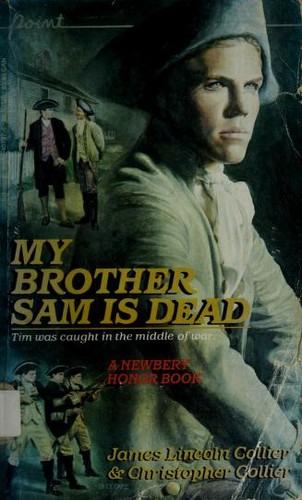
My Brother Sam Is Dead
James Lincoln Collier and Christopher Collier (1974)
“Two brothers. One war. No winners. A shattering story about what the Revolution actually cost the families who lived through it.”
Characters in My Brother Sam Is Dead
by James Lincoln Collier and Christopher Collier · 1974 · 6 characters analyzed
Cast: Tim Meeker, Sam Meeker, Life (Eliphalet) Meeker, Mother Meeker, Betsy Read, General Israel Putnam.
Character Analysis
Thirteen at the novel's start, Tim tells the story from old age — which means the reader knows he survived, but not what surviving cost him. He is the novel's moral center because he belongs to neither side. He loves Sam and respects his father, and loses both. His final uncertainty about the war is not weakness; it is the only honest response to everything he witnessed.
Conversational, uncertain, honest about his own confusion. Reports what he sees and admits what he doesn't understand.
Sam is brave, principled, educated, and wrong in the ways that cost him everything. He steals the family's weapon to fight for liberty and leaves them undefended. He comes back to protect them and is caught in a system that can't distinguish protection from theft. He dies for a cause that kills him. The Colliers don't undermine his idealism — they show what it costs.
Formal and rhetorical when arguing politics — Yale-educated. Simpler when speaking to family.
Life is right about almost everything and unable to prevent any of it. He predicts that the war will destroy his family. His prediction is completely accurate. He dies on a prison ship not as a soldier but as a bystander caught in a conflict he tried to stay out of. His death is the novel's first proof that neutrality offers no protection in a civil war.
The most underwritten major character, which is itself a comment on how history treats women who managed households through wars. She is capable, grief-stricken, and entirely without self-pity. Her plea to Putnam is the most direct emotional appeal in the novel. It fails. She continues running the tavern.
Terse, practical, emotional only in extremity. Her language is the language of someone who manages by doing, not speaking.
In love with Sam and committed to the Patriot cause with a passion that is admirable and entirely unaware of what it costs people like the Meekers. She represents the idealism that drives the Revolution among those not directly in its path of destruction.
A real Revolutionary War general, rendered by the Colliers as a man who is not cruel but who is trapped by the demands of command. His execution of Sam is both historically plausible and morally devastating. The Colliers refuse to let him be simply evil, because the system that kills Sam doesn't require evil people — it only requires people following orders they believe are necessary.