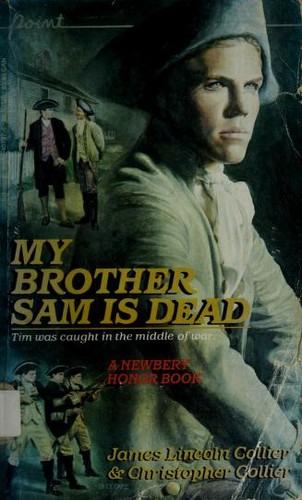
My Brother Sam Is Dead
James Lincoln Collier and Christopher Collier (1974)
“Two brothers. One war. No winners. A shattering story about what the Revolution actually cost the families who lived through it.”
My Brother Sam Is Dead— Historical Context & Author Background
Author: James Lincoln Collier and Christopher Collier · Published 1974· Era: Contemporary / Historical Fiction·215 pages
Themes explored: war, family, loyalty, morality, innocence, loss, revolution, perspective
About James Lincoln Collier and Christopher Collier
James Lincoln Collier (born 1928) is a jazz musician and writer of children's and young adult fiction. Christopher Collier (1930-2022) was a professional historian at the University of Connecticut specializing in colonial and Revolutionary-era Connecticut. The collaboration was unusual and productive: James wrote the narrative, Christopher supplied the historical research and vetting. Christopher's scholarly work on Connecticut Loyalism directly shaped the novel's refusal to romanticize the Revolution. The book was published in 1974, a year before the Bicentennial — a deliberate intervention into what the Colliers saw as uncritical patriotic celebration.
Life → Text Connections
How James Lincoln Collier and Christopher Collier's real experiences shaped specific elements of My Brother Sam Is Dead.
Christopher Collier was a professional historian of colonial New England who had documented the experiences of Loyalists in Connecticut
The novel's historically accurate depiction of Redding as a Loyalist community, prison ship conditions, and the reality of Patriot-on-Patriot violence
The novel's emotional arguments are grounded in documented history. The Meekers are fictional but their suffering was real for thousands of Connecticut families.
The novel was published in 1974, the year before America's Bicentennial celebrations
The deliberate anti-romantic treatment of the Revolution — the Colliers explicitly wrote against the heroic narrative they expected the Bicentennial would promote
Context shapes argument. The book was designed as a corrective to a specific cultural moment of uncritical nationalism.
James Lincoln Collier's work in jazz gave him access to African American musical and cultural history
The novel's awareness of who the Revolution did and did not liberate — the enslaved people who appear briefly in the background of Redding
The Colliers understood that 'liberty' in 1776 was a selective concept, and the novel's ambivalence about the Revolution partly reflects that understanding.
Historical Era
American Revolutionary War, 1775-1783 — specifically Loyalist Connecticut
How the Era Shapes the Book
The Colliers chose the Revolution's most uncomfortable truths: that it was a civil war, that Loyalists were not villains, that the Continental Army executed its own soldiers, and that the people who suffered most were often civilians caught between forces. The Valley Forge crisis created the very military discipline that killed Sam. The British prison ships created the conditions that killed Life. The Cowboys and Skinners were real and documented. The history makes the fiction inescapable.
Why My Brother Sam Is Dead Matters Historically
One of the first young adult novels to present the American Revolution as morally ambiguous rather than heroic. A National Book Award finalist in 1975. Regularly named to lists of the most important works of young adult historical fiction. Taught in nearly every American middle school as a counterpoint to more romantic treatments of the Revolution.
- First major YA novel to present a Loyalist family sympathetically without making them villains
- First novel for young readers to depict an American soldier executed by his own army as a wrongful death
- Among the first American historical fiction titles to include a scholarly historical note for young readers, grounding the fiction in documented fact
Frequently challenged in school libraries and classrooms for its depiction of violence (particularly the execution scene), its 'anti-American' treatment of the Revolution, and its moral ambiguity about whether the war was justified. Challenged in multiple states on grounds that it undermines patriotism. The challenges rather prove the Colliers' point about how America prefers its founding myths.