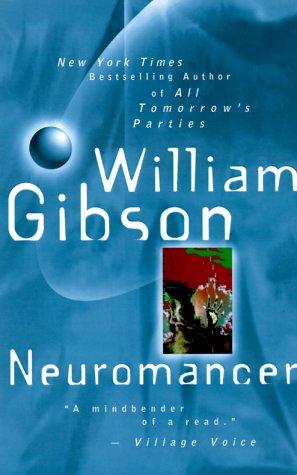
Neuromancer
William Gibson (1984)
“The novel that invented cyberpunk, written by a man who had never touched a computer, on a manual typewriter.”
Neuromancer— Historical Context & Author Background
Author: William Gibson · Published 1984· Era: Cyberpunk / Postmodern·271 pages
Themes explored: artificial-intelligence, cyberspace, corporatism, identity, addiction, transcendence, posthumanism
About William Gibson
William Ford Gibson (born 1948) wrote Neuromancer on a 1927 Hermes portable typewriter, having never used a computer. He was a draft dodger who moved from South Carolina to Toronto in 1968, steeped in the counterculture, punk rock, and the New Wave of science fiction. He had published a handful of short stories — 'Johnny Mnemonic,' 'Burning Chrome' — when Terry Carr commissioned Neuromancer for Ace Science Fiction Specials. Gibson wrote it in a state of terror, convinced that the film Blade Runner (1982) had already visualized everything he was trying to describe. The novel won the Hugo, Nebula, and Philip K. Dick awards — the science fiction triple crown — and is credited with launching the cyberpunk genre and predicting the cultural shape of the internet decades before the World Wide Web existed.
Life → Text Connections
How William Gibson's real experiences shaped specific elements of Neuromancer.
Gibson had never used a computer when he wrote the novel that defined computer culture. His vision of cyberspace came from watching kids play arcade games in Vancouver.
The matrix is described in terms of light, geometry, and flight — sensory and spatial, not technical. Cyberspace is an experience, not a protocol.
Gibson's ignorance of actual computing freed him to imagine cyberspace as a phenomenological space rather than a technical system. The result was more prophetic than any technically informed prediction.
Gibson was a Vietnam-era draft dodger who moved to Canada — an outsider to American military-industrial culture, observing it from across a border.
The novel's critique of military-corporate power (Screaming Fist, zaibatsus, the Turing Police) has the clarity of an outsider's perspective.
Like Nick Carraway's Midwest distance from East Egg, Gibson's Canadian exile gave him the angle to see American techno-capitalism clearly.
Gibson was deeply immersed in punk culture — the DIY aesthetic, the distrust of institutions, the embrace of urban decay as authentic.
Case is a punk — no allegiance to institutions, identity constructed from street culture and subcultural knowledge, contemptuous of corporate power even while dependent on its infrastructure.
Cyberpunk is punk plus cyber. The genre's political stance — anti-corporate, pro-street, suspicious of authority — comes directly from Gibson's subcultural roots.
Gibson saw Blade Runner shortly before finishing Neuromancer and nearly abandoned the novel, believing Ridley Scott had already realized his vision visually.
The novel's visual imagination — neon-lit streets, rain, Asian signage, retrofitted technology — overlaps with but exceeds Blade Runner's aesthetic.
Gibson pushed beyond the shared cyberpunk visual vocabulary into territory film couldn't reach: the interior experience of cyberspace, the phenomenology of jacking in.
Historical Era
Early 1980s — Reagan era, Cold War, nascent personal computing, Japanese economic ascendancy
How the Era Shapes the Book
Gibson wrote at the exact moment when personal computing was entering mainstream culture but before the internet existed publicly. This liminal position allowed him to imagine cyberspace as an experiential space rather than a technical network. The novel's Japanese-inflected corporate dystopia reflects genuine 1980s American anxiety about Japanese economic dominance — an anxiety that proved temporary but that Gibson transmuted into a permanent insight about post-national corporate power. The Cold War backdrop gives Screaming Fist its plausibility and the Turing Police their institutional logic: AI regulation as arms control.
Why Neuromancer Matters Historically
Neuromancer launched the cyberpunk genre, coined terminology that migrated into real computing and popular culture ('cyberspace,' 'the matrix,' 'ICE'), and predicted the cultural experience of the internet decades before the World Wide Web. It won the Hugo, Nebula, and Philip K. Dick awards — the only novel to sweep all three. It is the foundational text of digital culture, influencing everything from The Matrix to Bitcoin to the aesthetics of Silicon Valley.
- First novel to win the Hugo, Nebula, and Philip K. Dick awards simultaneously
- Coined 'cyberspace' as a term for virtual networked reality — now a standard English word
- First novel to imagine the internet as an immersive experiential space rather than a communication tool
- Launched cyberpunk as a recognized literary genre and aesthetic movement
- First major fiction to treat artificial intelligence as a character with agency rather than a plot device
Occasionally challenged in schools for drug use, sexual content, and violence. More commonly excluded from curricula by the soft gatekeeping of genre prejudice — classified as 'science fiction' and therefore not 'literary,' despite its prose quality, philosophical depth, and canonical status in postmodern studies.