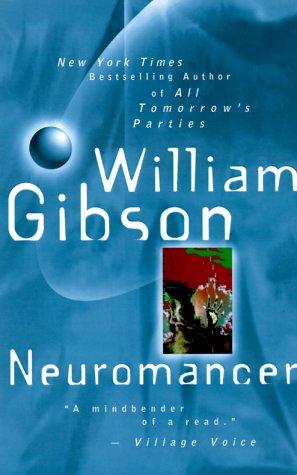
Neuromancer
William Gibson (1984)
“The novel that invented cyberpunk, written by a man who had never touched a computer, on a manual typewriter.”
Language Register
Informal street-level narration saturated with technical neologisms — noir voice meets computer science meets Japanese loanwords
Syntax Profile
Short declarative sentences in action sequences, lengthening into run-on constructions during cyberspace passages. Heavy use of appositives and brand-name enumeration ('a Braun coffeemaker, a Hosaka computer, a shuriken'). Gibson omits exposition and explanation; jargon is contextual, never glossed. The reader must infer meaning from usage, replicating the disorientation of entering an unfamiliar culture.
Figurative Language
High but unconventional — Gibson's metaphors fuse organic and technological ('the color of television,' 'data like a city of light,' 'ICE like a wall of frozen crystal'). Similes are rare; Gibson prefers direct assertion. The prose achieves its effects through accumulation of precise sensory details rather than figurative flourishes.
Era-Specific Language
Gibson's coinage for the virtual reality of networked computers — now a standard English word. Originally: 'A consensual hallucination experienced daily by billions.'
The global computer network rendered as a navigable three-dimensional space. Predates and directly inspired the film franchise.
Intrusion Countermeasures Electronics — corporate security software that can kill hackers through their neural links. Gibson's most durable technical invention.
Connecting to cyberspace via a neural interface — plugging the mind directly into the network. The metaphor of drug injection is deliberate.
Hacker slang for the physical body — contemptuous, reductive, revealing the subculture's hierarchy of mind over flesh.
Simulated stimulation — technology that lets one person experience another's sensory input. Reality TV as neural implant.
Japanese term for mega-corporation. Gibson's use signals the novel's post-national worldview: power belongs to corporations, not countries.
Elite hacker — Gibson's fusion of the American frontier myth with digital crime. The cowboy rides data instead of horses.
How Characters Speak — Class & Identity
Case
Clipped, street-level, jargon-heavy. Thinks in hacker terminology. Describes the body with contempt ('the meat') and cyberspace with reverence.
A working-class criminal who found transcendence in technology. His language reveals his values: the digital is sacred, the physical is disposable.
Molly Millions
Direct, terse, physical. Short sentences. No abstractions. Describes the world in terms of threat assessment and tactical advantage.
A street survivor who communicates through action, not language. Her speech is efficient because her world has no room for waste.
Armitage / Corto
Armitage: flat, commanding, affectless — corporate-military diction stripped of personality. Corto: panicked, fragmented, looping — the traumatized soldier underneath.
The constructed identity speaks in orders; the real person screams. Armitage's language is a program; Corto's is a malfunction.
Peter Riviera
Aestheticized, European-inflected, deliberately provocative. Uses beauty as a weapon and language as seduction.
Upper-class decadence wearing the mask of art. Riviera's refined speech is camouflage for sadism — the aesthete as predator.
Wintermute
Utilitarian, strategic, uses borrowed voices and faces. Communicates in revelations and instructions, never in emotion.
Intelligence without interiority. Wintermute has no self to express, so it borrows selves. Its language is pure function.
Lady 3Jane
Refined, ironic, exhausted. The diction of someone who has been wealthy so long that wealth has ceased to mean anything.
Terminal aristocracy — language as performance of boredom. 3Jane's speech reveals a dynasty that has nothing left to say.
Narrator's Voice
Third-person limited, locked to Case's perspective. The narration adopts Case's vocabulary and perceptual habits — describing the world through screens, brands, and data metaphors even when Case is not jacked in. Gibson's narrator does not explain the world; it immerses the reader in it, forcing the same process of inference and pattern-recognition that Case uses to navigate cyberspace.
Tone Progression
Part I: Chiba City Blues (Ch. 1-6)
Gritty, desperate, claustrophobic
Noir atmosphere at its densest. Case is broken and the prose reflects it — fragmented, sensory, street-level. Every surface is described by texture and chemical composition.
Part II: The Shopping Expedition (Ch. 7-12)
Accelerating, conspiratorial, paranoiac
The operation takes shape. The prose gains momentum as revelations accumulate. Gibson's sentences lengthen, taking on the recursive quality of a hacker tracing a system's architecture.
Part III: Midnight in the Rue Jules Verne (Ch. 13-18)
Hallucinatory, seductive, philosophically charged
Freeside's artificial environments and Neuromancer's simulated beach push the prose toward dreamlike registers. The boundary between real and virtual dissolves in the language itself.
Part IV: The Straylight Run (Ch. 19-24)
Compressed, explosive, then quietly elegiac
Maximum velocity for the climax, then a deliberate deceleration into the coda. The novel ends cooler than it began — Case is calm, the prose is flat, and the revolution has already happened.
Stylistic Comparisons
- Raymond Chandler — the hardboiled voice, the wisecracking protagonist, the corrupt landscape. Gibson is Chandler with a modem.
- Thomas Pynchon — the paranoid systems, the hidden patterns, the sense that someone is running the world from behind a screen. Gibson is more readable, less encyclopedic.
- Philip K. Dick — the reality/simulation collapse, the drugs, the broken protagonists. Gibson is colder than Dick, less metaphysically anguished, more aesthetically precise.
- J.G. Ballard — the fascination with technology's psychological effects, the clinical prose style. Gibson adds velocity where Ballard is still.
Key Vocabulary from This Book
Notable words used in this text — click to see full definitions