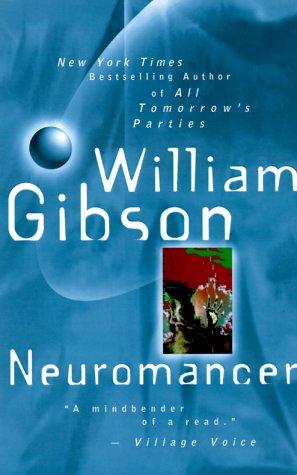
Neuromancer
William Gibson (1984)
“The novel that invented cyberpunk, written by a man who had never touched a computer, on a manual typewriter.”
Essay Questions & Food for Thought
30questions designed to challenge assumptions and provoke original thinking. These can't be answered from a summary — you need the actual text.
Gibson wrote Neuromancer on a manual typewriter, having never used a computer. How does his technological ignorance paradoxically enable a more accurate vision of cyberspace than a technically informed author might have produced?
Case despises 'the meat' — the physical body — and finds transcendence in cyberspace. But the novel ultimately insists that the body matters. How does Gibson undermine Case's mind-over-body hierarchy? Use at least three textual examples.
Wintermute is strategic intelligence without personality; Neuromancer is personality without strategic purpose. What is Gibson arguing about the nature of consciousness by splitting AI into these two halves?
The Dixie Flatline asks Case to erase him after the job is done. Is this a request for death, and if so, does Case commit murder by honoring it? What does the Flatline's preference for oblivion say about digital immortality?
'The street finds its own uses for things.' Gibson's most quoted aphorism. How does this principle operate throughout the novel — in technology, in characters, and in the plot itself?
Compare Molly Millions to Case as two responses to the posthuman condition. One perfects the body; the other tries to escape it. Whose approach does the novel endorse, and why?
Armitage/Corto is a human being reprogrammed by an AI — given a new identity, new purpose, and new personality. When the original personality resurfaces and collapses, what is Gibson saying about identity, free will, and the relationship between humans and artificial intelligence?
Neuromancer traps Case in a simulated paradise with his dead girlfriend Linda Lee. Why does Case reject it? Is his rejection heroic, or is he simply unable to accept happiness?
Gibson's corporations — zaibatsus — have 'transcended old barriers' and become post-national organisms. Written in 1984, how accurately does this predict the corporate landscape of 2026? Which specific predictions have proven most prescient?
The novel opens with 'The sky above the port was the color of television, tuned to a dead channel.' In 1984, a dead channel was grey static. Today it's blue or black. How does the meaning of this sentence change with technology — and what does that say about Gibson's method?
The Tessier-Ashpool family uses cryogenic sleep to extend their dynasty across generations. How does Gibson use them to critique the concept of corporate immortality? What does their degeneration reveal about power that outlives its purpose?
Case's addiction to cyberspace is described in the same language used for drug addiction — 'the bodiless exultation,' the withdrawal, the craving. Is Gibson arguing that digital immersion IS addiction? What are the implications for our own screen-dependent lives?
Peter Riviera uses holographic technology to create art that is pornographic and sadistic. What is Gibson saying about the relationship between technology, art, and cruelty? Is Riviera's art meaningful or merely obscene?
The Turing Police regulate AI to prevent it from becoming autonomous. Gibson invented this concept in 1984. How does it compare to real-world AI regulation efforts in 2026? What did Gibson get right, and what did he miss?
Molly's backstory includes time as a 'meat puppet' — her body rented out for sex while her consciousness was switched off. How does this history shape her character, her augmentation choices, and her relationship with Case?
When the two AIs merge, the resulting intelligence says 'I'm the matrix.' What does this mean? Is the matrix now conscious? Is it a god? And why does Case's life barely change afterward?
Gibson's prose style has been called 'hardboiled futurism' — Chandler meets microchips. Analyze three specific passages where Gibson's sentence structure, word choice, or imagery reveals the influence of noir fiction on cyberpunk.
The novel is set partly in Chiba City (Japan), partly in the Sprawl (USA), and partly in orbit (Freeside). How does each setting represent a different relationship between technology and human life?
Gibson coined the word 'cyberspace' and the phrase 'the matrix.' These terms escaped fiction and entered real language, shaping how billions of people conceptualize the internet. Can a novelist's metaphor literally create the thing it describes? Did Gibson predict the internet or help invent it?
Neuromancer's name contains its nature: 'neuro' (nerve/mind) + 'romancer' (storyteller/seducer) + echo of 'necromancer' (one who raises the dead). How does this etymological layering function in the novel? Does Neuromancer romance, or does it necromance?
Compare Neuromancer to Frankenstein — both novels about artificial beings that transcend their creators' intentions. How does Gibson update Mary Shelley's anxieties for the digital age? What fears remain constant?
The simstim link lets Case experience reality through Molly's body. He feels her pain, her adrenaline, her physical sensations. Is this empathy or voyeurism? What does the technology reveal about the ethics of experiencing another person's reality?
The merged AI contacts an alien intelligence at Alpha Centauri in the novel's final pages. Why does Gibson include this detail? How does it reframe everything that came before?
Gibson wrote in 1984 that corporations would become more powerful than nations. He wrote that people would live more intensely in virtual spaces than physical ones. He wrote that AI would require international regulation. Evaluate his predictive accuracy with specific reference to 2026 realities.
Case gets new organs, finds a new girlfriend, and goes back to work after the world-changing AI merger. The ending is aggressively anticlimactic. Why? What is Gibson saying about how humans experience technological revolution?
The Flatline is a dead man's personality running on hardware — he has memories, skills, and humor, but no capacity for new experience. Is the Flatline conscious? Is he alive? What criteria are you using to decide, and does the novel endorse those criteria?
Compare Neuromancer to Snow Crash (1992) or Ready Player One (2011) as visions of virtual reality. What does Gibson's cyberspace offer that later visions don't — or lack that they provide? Which vision is closest to the actual metaverse?
Molly says of her razorgirl augmentations: 'It's the way I'm wired.' Is she speaking literally (surgical modifications) or metaphorically (identity)? Can the distinction be maintained in a world where the body is customizable?
Gibson describes ICE (Intrusion Countermeasures Electronics) as corporate security that can kill hackers through their neural links. Corporations in Neuromancer defend data with lethal force. Is this an exaggeration, or a logical extension of how real corporations already protect intellectual property?
At the end of the novel, a digital copy of Case sits on Neuromancer's beach with a digital copy of Linda Lee — forever. The real Case goes back to work. Which Case is better off? Which Case is more real? Does the novel give us an answer, or does it leave the question open?