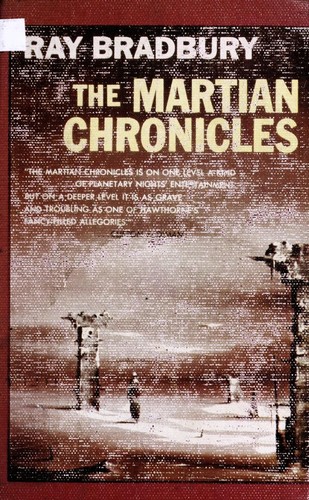
The Martian Chronicles
Ray Bradbury (1950)
“A book about Mars that is really about Earth -- written by a man who never learned to drive, distrusted machines, and saw the American frontier myth for the beautiful lie it always was.”
The Martian Chronicles— Historical Context & Author Background
Author: Ray Bradbury · Published 1950· Era: Postmodern / Cold War·222 pages
Themes explored: colonialism, nostalgia, technology, loneliness, nuclear-fear, home, identity, memory
About Ray Bradbury
Ray Douglas Bradbury (1920-2012) never learned to drive a car, never flew in an airplane until late in life, and distrusted most technology -- and yet became the most beloved science fiction writer in American literature. Born in Waukegan, Illinois, he grew up during the Depression, moved to Los Angeles at fourteen, and educated himself in public libraries. He sold newspapers on street corners to fund his writing. He wrote every day of his life, producing over 600 stories, and considered himself a fantasy writer, not a science fiction writer. He wrote The Martian Chronicles at twenty-nine, in a burst of creative energy between 1945 and 1950, assembling previously published stories into a unified sequence at the suggestion of an editor. He never visited Mars. He barely left Southern California. His Mars was Waukegan, Illinois, with red sand.
Life → Text Connections
How Ray Bradbury's real experiences shaped specific elements of The Martian Chronicles.
Bradbury grew up in Waukegan, Illinois, during the Depression -- a small Midwestern town that became his lifelong imaginative landscape
Mars is described in the vocabulary of small-town Illinois -- front porches, elm trees, quiet streets. The Martian cities have the feel of idealized Midwestern towns
Bradbury's Mars is not a scientific extrapolation but a nostalgic projection. The book is about the loss of the America he grew up in, displaced onto an alien planet.
Bradbury educated himself entirely through public libraries, reading omnivorously from age eight, and credited libraries with saving his life
'Usher II' and the book-burning subplot are written with the fury of someone who owes everything to libraries and sees them threatened
The censorship theme in the Chronicles (and later in Fahrenheit 451) is not abstract for Bradbury. Books literally made him. Destroying books is, in his universe, murder.
Bradbury wrote the Chronicles between 1945 and 1950, during the dawn of the nuclear age -- Hiroshima, Nagasaki, the Soviet bomb test of 1949
'There Will Come Soft Rains' and the nuclear destruction of Earth are direct responses to the lived terror of atomic annihilation
The nuclear anxiety in the Chronicles is not speculative. Bradbury was writing in real time about a real threat, and the urgency is audible in every sentence.
Bradbury never learned to drive and distrusted technology throughout his life, preferring typewriters to computers
The anti-technology humanism that pervades the collection -- machines as replacements for, rather than enhancements of, human connection
Bradbury's technophobia is not Luddism but a philosophical position: technology is dangerous not because it fails but because it succeeds at making human relationships unnecessary.
Historical Era
1945-1950 America -- early Cold War, nuclear anxiety, postwar expansion, McCarthyism
How the Era Shapes the Book
The Martian Chronicles is a product of the brief, terrifying period between the first atomic bombs and the full institutionalization of Cold War culture. Bradbury wrote it when nuclear annihilation was new enough to be genuinely shocking and the American suburban expansion was transforming the landscape in ways that looked, to Bradbury, like colonization of America's own countryside. The book-burning in 'Usher II' reflects McCarthyist censorship. The racial dynamics in 'Way in the Middle of the Air' reflect the early civil rights struggle. The nuclear ending reflects what every American in 1950 believed was possible any Tuesday.
Why The Martian Chronicles Matters Historically
The Martian Chronicles proved that science fiction could be literature -- that genre fiction could address colonialism, nuclear anxiety, censorship, and the human condition with the same seriousness and beauty as any 'literary' novel. Published in 1950, it was immediately recognized as something different from the pulp SF of its era. Christopher Isherwood reviewed it as a work of art, not a genre exercise. It became the book that English teachers could assign without apologizing for the genre label, and it opened the door for science fiction to be taken seriously in academic contexts.
- One of the first science fiction works accepted as serious literature by the mainstream critical establishment
- Pioneered the 'fix-up novel' structure -- linked short stories creating a unified narrative arc -- that influenced works from Asimov's Foundation to Mitchell's Cloud Atlas
- One of the first American works to use science fiction explicitly as colonial allegory, predating postcolonial readings of SF by decades
Challenged in schools primarily for its depiction of book burning (ironically), its treatment of religion, and its racial content in 'Way in the Middle of the Air.' Bradbury himself was furious about censorship of his work and wrote extensively about the irony of banning a book that warns against banning books.