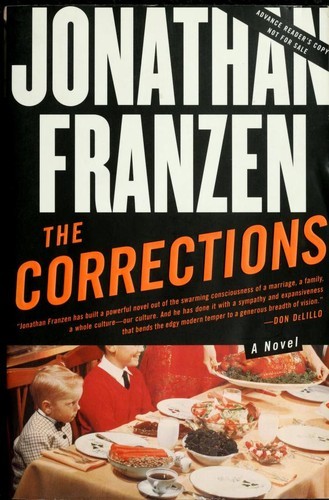
The Corrections
Jonathan Franzen (2001)
“A Midwestern family unravels across a continent, each member fleeing the same house and arriving at the same emptiness.”
This page prints on a single page. Use Ctrl+P / Cmd+P.
The Corrections
Jonathan Franzen (2001) · 568pages · Contemporary Literary Fiction · 3 AP appearances
Summary
Alfred and Enid Lambert are aging in their St. Jude home — he declining with Parkinson's and dementia, she desperate for one last Christmas with all three adult children. Gary, a Philadelphia banker, fights depression and his wife's campaign to declare him clinically unwell. Chip, a fired academic, flees to Lithuania to help a fraudster build a website for a corrupt government. Denise, a brilliant chef, loses her restaurant job after affairs with both her employer and his wife. All three children return for Christmas, but the reunion only confirms that the family cannot be corrected. Alfred enters a nursing home. Enid begins, tentatively, to live for herself.
Why It Matters
The Corrections revived the social novel as a form that could compete with postmodern experimentation for literary prestige. Published in September 2001 — days before 9/11 — it became the last great novel of the pre-terror American literary landscape, a comprehensive portrait of 1990s America tha...
Themes & Motifs
Diction & Style
Register: High literary register with sustained satirical undertone — Latinate vocabulary, complex syntax, punctuated by devastating colloquial deflation
Narrator: Third-person omniscient with sustained free indirect discourse — the narrator slides between characters' consciousnes...
Figurative Language: Moderate
Historical Context
Late 1990s America — dot-com bubble, pharmaceutical boom, post-Cold War triumphalism: The novel is set at the precise historical moment when late-twentieth-century American capitalism reached its zenith and began to crack. The stock market correction that gives the novel its title i...
Key Characters
Talking Points
- Why does Franzen title the novel 'The Corrections' rather than 'The Correction'? What does the plural form imply about the novel's argument — that there is not one reckoning but many, ongoing, and never final?
- Each Lambert child's section reads as a different literary genre — Chip as academic satire, Gary as suburban psychological realism, Denise as food-and-desire narrative. Why does Franzen assign each child a different genre, and what does this formal choice reveal about how family position shapes identity?
- Alfred's Parkinson's disease systematically destroys every form of control he ever exercised. Is Franzen using the disease purely as a medical reality, or is it also functioning as a metaphor for something happening to American patriarchal authority more broadly?
- The novel's most surreal passages — Alfred's hallucinated talking turd, the cruise ship episodes — break sharply from Franzen's otherwise realist mode. Why does Franzen abandon realism precisely when depicting Alfred's interior experience?
- Enid Lambert is arguably the novel's true protagonist, yet she is the character most consistently underestimated — by her family, by the reader, and by the narrative voice itself. When does Franzen's treatment of Enid shift from satirical to compassionate, and why?
Notable Quotes
“The madness of an autumn prairie cold front coming through.”
“She was asking herself what it would take to get all five Lamberts together one last time.”
“He was going to have to be a man about this and go to Lithuania.”
Why Read This
Because every family is a system of inherited damage, and The Corrections is the most precise map of how that damage transmits across generations. Franzen writes about the things families cannot say to each other with the kind of specificity that ...