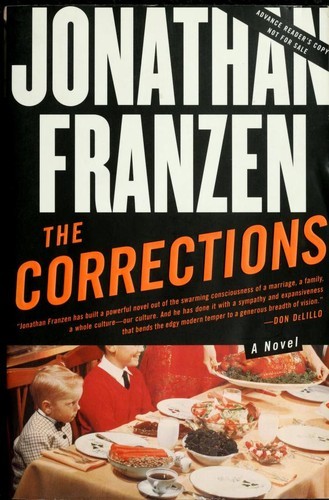
The Corrections
Jonathan Franzen (2001)
“A Midwestern family unravels across a continent, each member fleeing the same house and arriving at the same emptiness.”
For Students
Because every family is a system of inherited damage, and The Corrections is the most precise map of how that damage transmits across generations. Franzen writes about the things families cannot say to each other with the kind of specificity that makes you recognize your own dinner table. The novel is long, but every section operates as a different genre — academic satire, suburban psychological thriller, picaresque comedy, restaurant drama — so the 568 pages never feel monotonous. If you have ever watched a parent decline and not known what to say, this novel knows.
For Teachers
A masterclass in free indirect discourse, genre modulation, and structural architecture. Each Lambert child's section can be taught as a standalone genre exercise — Chip as academic satire, Gary as domestic realism, Denise as food-and-desire narrative — while the novel's overarching structure demonstrates how family dynamics create narrative form. The diction analysis alone supports weeks of close reading: how each character's vocabulary reveals their class position, their psychological defenses, and their relationship to the family they are trying to escape.
Why It Still Matters
The corrections never stop. Every generation inherits the previous generation's unfinished business — the silences, the resentments, the deferred desires — and either perpetuates them or, if lucky, adjusts. Franzen's novel is about a specific family in a specific historical moment, but its argument is universal: you cannot fix your family, you cannot repeat the past, and the only correction available to you is the modest, ongoing work of figuring out what you actually want and learning to say it out loud.