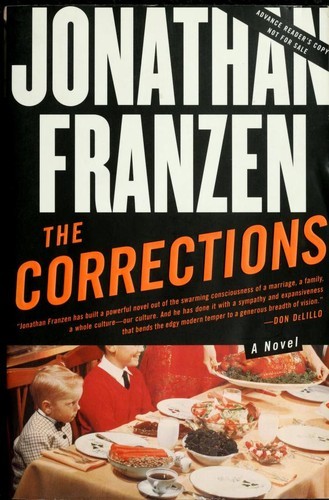
The Corrections
Jonathan Franzen (2001)
“A Midwestern family unravels across a continent, each member fleeing the same house and arriving at the same emptiness.”
The Corrections— Historical Context & Author Background
Author: Jonathan Franzen · Published 2001· Era: Contemporary Literary Fiction·568 pages
Themes explored: family, american-decline, consumerism, mental-illness, aging, identity, correction-as-metaphor
About Jonathan Franzen
Jonathan Franzen was born in 1959 in Western Springs, Illinois, and raised in Webster Groves, Missouri — a Midwestern suburb that informs St. Jude down to its brick ranch houses and dinner-table silences. His father Earl, a railroad civil engineer, developed Alzheimer's disease, and his decline is the unmistakable autobiographical engine of Alfred Lambert's story. Franzen's parents' marriage — his mother's suppressed vitality, his father's emotional withdrawal — maps directly onto Enid and Alfred. Franzen published The Corrections in 2001 after a decade of relative obscurity following his first two novels. The book won the National Book Award and became the center of a cultural firestorm when Franzen expressed ambivalence about Oprah Winfrey's selection of the novel for her Book Club, leading Oprah to rescind the invitation. The controversy made Franzen a symbol of literary elitism — a reputation he has spent two decades both resisting and confirming.
Life → Text Connections
How Jonathan Franzen's real experiences shaped specific elements of The Corrections.
Franzen's father Earl was a civil engineer for a railroad who developed Alzheimer's disease in the 1990s
Alfred Lambert is a railroad engineer whose Parkinson's and dementia systematically dismantle his identity
The novel's most emotionally raw passages — Alfred's hallucinations, his incontinence, his loss of language — are grounded in Franzen's direct observation of his father's decline. The specificity is autobiographical, not clinical.
Franzen grew up in a Midwestern suburb with a stoic, emotionally reserved father and a socially anxious mother
The Lambert family dynamics — Alfred's silence, Enid's desperate cheerfulness, the children's various modes of escape
Franzen has acknowledged that the family is drawn from life. The novel's understanding of Midwestern emotional suppression — the things that cannot be said at the dinner table — comes from inside the culture, not from observation.
The Oprah controversy — Franzen's public discomfort with being selected for Oprah's Book Club, seen as elitist snobbery
Chip Lambert's intellectual pretension and simultaneous dependence on the consumer culture he critiques
The controversy dramatized exactly the tension the novel explores: the American intellectual's relationship to popular culture, the desire to be both serious and successful, the impossibility of critiquing a system from which you benefit.
Franzen spent the 1990s struggling with his second novel, Strong Motion, and questioning whether the literary novel could still matter
The novel's sustained engagement with the question of whether art, thought, or critique can intervene in American consumer culture
The Corrections is Franzen's answer to his own crisis of faith: a novel that succeeds by embracing the family story he once considered too conventional, too Midwestern, too domestic to be 'important.'
Historical Era
Late 1990s America — dot-com bubble, pharmaceutical boom, post-Cold War triumphalism
How the Era Shapes the Book
The novel is set at the precise historical moment when late-twentieth-century American capitalism reached its zenith and began to crack. The stock market correction that gives the novel its title is both a literal event (Axon Corporation's stock will crash) and a metaphor for the broader reckoning the Lambert family undergoes. Alfred's railroad — physical, productive, Midwestern — has been replaced by Axon's pharmaceutical speculation: intangible, financialized, promising neurological miracles it cannot deliver. Chip's Lithuania adventure maps the export of American capitalism's fraudulent narratives to post-Soviet space. Gary's depression amid affluence embodies the era's central paradox: unprecedented material comfort producing unprecedented psychological distress. The novel argues that the 1990s correction was not just economic but civilizational — a reckoning with the discovery that the American project of endless growth, endless self-improvement, and endless optimism had reached its limits.
Why The Corrections Matters Historically
The Corrections revived the social novel as a form that could compete with postmodern experimentation for literary prestige. Published in September 2001 — days before 9/11 — it became the last great novel of the pre-terror American literary landscape, a comprehensive portrait of 1990s America that already intuited the instabilities about to erupt. It won the National Book Award, sold over three million copies, and established Franzen as the most prominent American novelist of his generation — a position cemented and contested by every subsequent book.
- Demonstrated that the domestic family novel could achieve the scope and ambition of postmodern systems fiction
- Pioneered the use of free indirect discourse rotating between family members as the primary structural device of a multi-protagonist novel
- One of the first major literary novels to treat pharmaceutical capitalism and neurological disease as central themes rather than background detail
Not widely banned, but frequently challenged in university syllabi for explicit sexual content (Denise's affairs, Chip's student relationship), graphic depictions of bodily deterioration, and perceived condescension toward Midwestern values — a criticism that misreads Franzen's ambivalence as contempt.